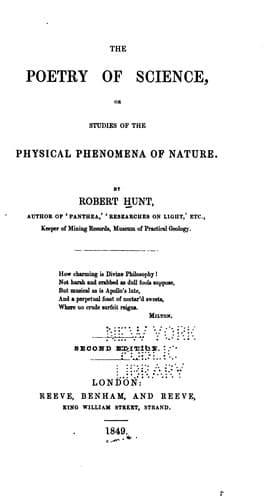
The Poetry of Science; or, Studies of the Physical Phenomena of NatureHunt, Robert
Philosophy
The Poetry of Science; or, Studies of the Physical Phenomena of Nature
Hunt, Robert
Physics; Science
All these formations show distinct evidence of their having been
deposited from still or slowly-flowing deep waters. Thus the eocene
appears in the Paris basin,--formed clearly at an estuary, in which
are mingled some interesting fresh-water deposits;--in the lacustrine
formations in Auvergne; also at Aix; and in the north of Italy. It
appears probable that, in the formations generally termed eocene, both
fresh-water and marine deposits have been confounded, and several
formations of widely-different eras regarded as the result of one. We
have not yet been furnished with any distinct and clear evidence to
show that the deposits of the Paris basin, and those of Auvergne,
are of the same age. At all events, it is sufficient for our present
purpose to know that they are the result of actions which are now as
general as they were when the plastic clay of Paris, and its sulphate
of lime, or the London clay, were slowly deposited.
As a general conclusion, we may decide that, at the eocene period,
existing continents were the sites of vast lakes, rivers, and
estuaries, and were inhabited by quadrupeds, which lived upon
their thickly-wooded margins. Many remains, allied to those of the
hippopotamus, have been found in the subsidences of this period.
Examples of the miocene or middle tertiary era are to be found in
Western France, over the whole of the great valley of Switzerland, and
the valley of the Danube. In these deposits we find the bones of the
rhinoceros, elephant, hippopotamus, and the dinotherium, an extinct
animal, possessing many very distinguishing features.[243]
The pliocene period has been termed the age of elephants, and is most
remarkable for the great mastodons and gigantic elks, with other
animals not very unlike those which are contemporaneous with man.
In the superficial layers of the earth, the diluvium, alluvium, peat
and vegetable soil, we have a continuation of the history of the
mutations of our globe and of its inhabitants, which has been here so
briefly sketched. They bring us up to the period when man appeared in
the world, since whose creation it is evident no very extensive change
has been produced upon the surface. We have viewed the phenomena of
each great epoch, marked as they are by new creations of organized
beings, and it would appear as if, through the whole series, from
the primary rocks up to the modern alluvial deposits, a progressive
improvement of the earth’s surface had been effected, to fit it at last
for the abode of the human race.
Public-domain text, read in full here on John Shaqi.
Reviews
Reviews
No reviews yet
Be the first to share your thoughts on this work.
Elsewhere in the archive
Join the Discussion
Join the discussion
Sign in to leave a comment or review.
Sign InorCreate an account