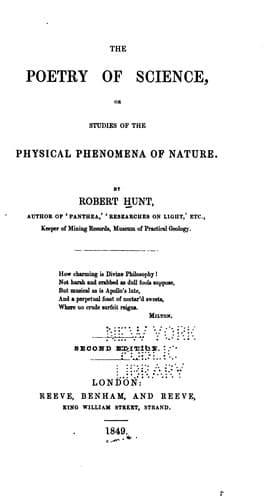
The Poetry of Science; or, Studies of the Physical Phenomena of NatureHunt, Robert
Philosophy
The Poetry of Science; or, Studies of the Physical Phenomena of Nature
Hunt, Robert
Physics; Science
power from the bottom of the sea, and many districts in South America
have been depressed by the same causes.
Changes as extensive have been, in all probability, effected by forces
“equally or more powerful, but acting with less irregularity, and so
distributed over time as to produce none of those interregnums of
chaotic anarchy which we are apt to think (perhaps erroneously) great
disfigurements of an order so beautiful and harmonious as that of
nature.”[246] These forces are, without doubt, even now in action.
Had it not been for these convulsive disturbances of the surface,
the earth would have presented an almost uniform plain, and it would
have been ill-adapted for the abode of man. The hills raised by the
disturbances of nature, and the valleys worn by the storms of ages,
minister especially to his wants, and afford him the means of enjoyment
which he could not possess had the surface been otherwise formed. The
“iced mountain tops,” condensing the clouds which pass over them, send
down healthful streams to the valleys, and supply the springs of the
earth, thus securing the fertility and salubrity of the distant plains.
The severities of climate are mitigated by these conditions, and both
the people of the tropics and those dwelling near the poles are equally
benefited by them.
Gravitation, cohesion, motion, chemical force, heat, and electricity,
must, from that hypothetical time when the earth floated a cloud of
nebulous vapour, in a state of gradual condensation up to the present
moment, have been exercising their powers, and regulating the mutations
of matter.
When the dry land was beneath the waters, and when darkness was upon
the face of the deep, the same great operations as those which are
now in progress in the depths of the Atlantic, or in the still waters
of our inland lakes, were in full activity. At length the dry land
appears; and--mystery of mysteries--it soon becomes teeming with life
in all the forms of vegetable and animal beauty, under the aspect of
the beams of a glorious sun.
Geology teaches us to regard our position upon the earth as one far
in advance of all former creations. It bids us look back through
the enormous vista of time, and see, shining still in the remotest
distance, the light which exposes to our vision many of nature’s holy
wonders. The elements which now make up this strangely beautiful fabric
of muscle, nerves, and bone, have passed through many ordeals, ere yet
it became fashioned to hold the human soul. No grain of matter has been
added to the planet, since it was weighed in a balance, and poised with
other worlds. No grain of matter can be removed from it. But in virtue
of those forces which seem to originate in the sun, “the soul of the
great earth,” a succession of new forms has been produced, as the old
things have passed away.
Public-domain text, read in full here on John Shaqi.
Reviews
Reviews
No reviews yet
Be the first to share your thoughts on this work.
Elsewhere in the archive
Join the Discussion
Join the discussion
Sign in to leave a comment or review.
Sign InorCreate an account