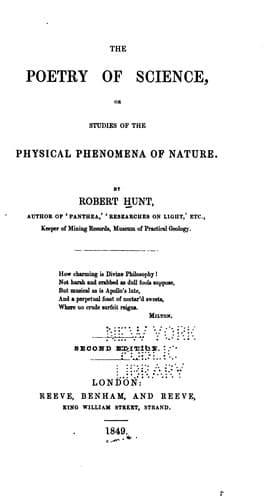
The Poetry of Science; or, Studies of the Physical Phenomena of NatureHunt, Robert
Philosophy
The Poetry of Science; or, Studies of the Physical Phenomena of Nature
Hunt, Robert
Physics; Science
Through the whole of the romance period of European literature,
nothing figures but serpents, “white and red,” toiling and fighting
underground,--thus producing earthquakes, as in the story of Merlin
and the building of Stonehenge. Flying monsters, griffins and others,
which now live only in the meaningless embellishments of heraldry,
appear to have been conceived by the earlier races of men as the
representatives of power. Curious is it, too, to find the same class
of ideas prevailing in the East. The monster dragons of the Chinese,
blazoned on their standards and ornamenting their temples;--the
Buddaical superstition that the world is supported on a vast elephant,
which stands on the back of a tortoise, which again rests on a serpent,
whose movements produce earthquakes and violent convulsions;--the rude
decorations also of the temples of the Aztecs, which have been so
recently restored to our knowledge by the adventurous travellers of
Central America,--all give expression to the same mythological idea.
Do not these indicate a faint and shadowy knowledge of a previous
state of organic existence? The process of communion between man of
the present, and the creations of a former world, we know not; it is
mysterious, and for ever lost to us. But even the most ignorant and
uncultivated races of mankind have figured for themselves the images
of creatures which, whilst they do really bear some resemblance to
things which have for ever passed away, do not, in the remotest degree,
partake of any of the peculiarities of existing creations.
The ichthyosaurus, and the plesiosaurus, and the pterodactylus, are
preserved in the rude images of harpies, of dragons, and of griffins;
and, although the idea of an elephant standing on the back of a
tortoise was often laughed at as an absurdity, Captain Cautley and
Dr. Falconer at length discovered in the hills of Asia the remains of
a tortoise in a fossil state of such a size that an elephant could
easily have performed the feat.[247]
Of the ammonites, we have more exact evidence; they were observed by
our forefathers, and called by them snake-stones. According to the
legends of Catholic saints they were considered as possessing a sacred
character:--
“Of these and snakes, each one
Was changed into a coil of stone
When holy Hilda prayed.”
And in addition to this petrifying process, one of decapitation is said
to have been effected; hence the reason why these _snake-stones_ have
no heads.
We also find, in the northern districts of our island, that the name of
“St. Cuthbert’s beads” is applied to the fossil remains of encrinites.
Public-domain text, read in full here on John Shaqi.
Reviews
Reviews
No reviews yet
Be the first to share your thoughts on this work.
Elsewhere in the archive
Join the Discussion
Join the discussion
Sign in to leave a comment or review.
Sign InorCreate an account