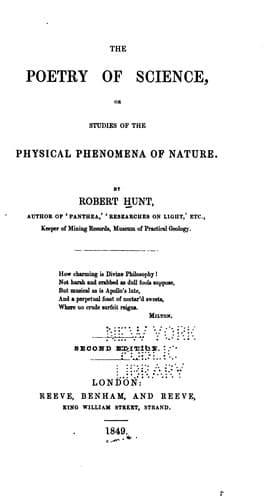
The Poetry of Science; or, Studies of the Physical Phenomena of NatureHunt, Robert
Philosophy
The Poetry of Science; or, Studies of the Physical Phenomena of Nature
Hunt, Robert
Physics; Science
If the experiment is continued, it will be found that under the
blue glass the plants grow rapidly, but weakly; and that instead of
producing leaves and wood they consist chiefly of stalk, upon which
will be seen here and there some abortive attempts to form leaves.
When the process of germination has terminated, if the young plant is
brought under the yellow glass, it grows most healthfully, and forms an
abundance of wood, the leaves having an unusually dark green colour,
from the formation of a large quantity of chlorophylle. Plants do not,
however, produce flowers with readiness under this medium; but if, at
the proper period, they are brought under the red glass, the flowering
and fruiting processes are most effectively completed.[260]
These experiments, simple as they are, prove to us the importance of
light: the _luminous principle_ of the sunbeam is exciting the vital
powers of the plant to decompose carbonic acid and form wood; and the
calorific agent, possibly under those modifications which have already
been noticed as belonging to the parathermic rays, is essential to the
production of flower and fruit.
Observations, which have been extended over many years, prove that
with the seasons these solar powers are, relatively to each other,
subject to an interesting change. In the spring, the actinic or
chemical power prevails, and during this period its agency is required
for the vitalization of the germ. As the summer comes on, the actinic
rays diminish, and those of light increase. Perhaps it would be more
strictly correct to say that the luminous intensity being increased,
the chemical power was retarded; the former expression implies a
variation in quantity, which may not be correct. We see the necessity
for this, since luminous power is required for the secretion of
the carbon, with which the woody fibre is formed, and also for the
elaboration of the proximate principles of the plant. Autumn, the
season of fruit, is characterized by an increase of the heat rays, and
a diminution of the others: this change being necessary, as science now
teaches us, for the due production of flower and fruit.
The calorific rays of the solar beam, to which the autumnal phenomena
of vegetation appear particularly to belong, are of a peculiar
character. They have been called, the Parathermic rays, and exhibit a
curious compound nature. To these rays we may refer the ripening of
fruit and grain, and the browning of the leaf before its fall. May not
the rise of the sap in spring be traced to the excitement of either
light or actinism, and its recession, in the autumn, to that power
from which the plant is found to bend, and which appears to be their
modified form of heat?
Public-domain text, read in full here on John Shaqi.
Reviews
Reviews
No reviews yet
Be the first to share your thoughts on this work.
Elsewhere in the archive
Join the Discussion
Join the discussion
Sign in to leave a comment or review.
Sign InorCreate an account