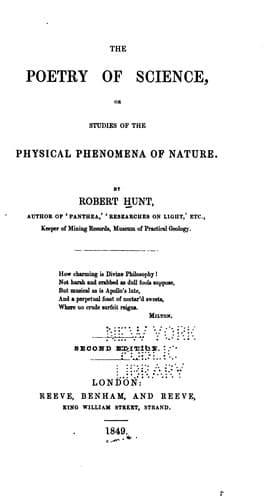
The Poetry of Science; or, Studies of the Physical Phenomena of NatureHunt, Robert
Philosophy
The Poetry of Science; or, Studies of the Physical Phenomena of Nature
Hunt, Robert
Physics; Science
Fungals are among the lowest forms of vegetation, but in these we have
peculiarities which appear to link them with the animal kingdom. Marcet
found that mushrooms absorbed oxygen, and disengaged carbonic acid.
In all probability this is only a chemical phenomenon of a precisely
similar character to that which we know takes place with decaying
wood. In the conversion of wood into _humus_, oxygen is absorbed, and
combining with the carbon, it is evolved as carbonic acid. Of course we
have the peculiar condition of vitality to modify the effect, and we
have, too, in this class of plants, the existence of a larger quantity
of nitrogen than is found in any other vegetating substance.
These few sketches of remarkable phenomena connected with vegetation
are intended to show merely the operations of the physical powers of
the universe, so far as we know them, upon these particular forms
of organization. During the process of germination, electricity is,
according to Pouillet, evolved; and again, in ripening fruits, there
appears to be some evidence of electrical currents. Vegetables are,
however, in the growing state, such good conductors of electricity,
that it is not, according to the laws of this force, possible that
they should accumulate it; so that the luminous phenomena stated to
have been observed cannot be due to this agency. We know, however,
that under every condition of change, whether induced by chemical or
calorific action, electricity is set in motion; and we have reasons
for believing that the excitation of light will also give rise to
electrical circulation.
The question, whether plants possess sensation, whether they have
any disposition of parts at all analogous to the nervous system of
animals, has been often put forward, but as yet the answers have been
unsatisfactory. The point is one well worthy all the attention of
the vegetable physiologist; but regarding plants as the link between
the animal and the mineral kingdom,--looking upon phyto-chemistry,
as exhibited by them, as the means employed to produce those more
complex organizations which exist in animals,--we necessarily consider
plants as mere natural machines for effecting organic arrangements,
and, as such, that they cannot possess any nervous sensibility.
Muscular contraction may be represented in many of their marvellous
arrangements; and any disturbance produced by natural or artificial
means would consequently effect a change in the operations of those
forces which combine to produce vegetable life. Indeed, the experiments
of Carlo Matteucci, already referred to, prove that an incision across
a leaf, the fracture of a branch, or the mere bruising of any part of
the plant, interferes with the exercise of that power which, under the
operation of luminous agency, decomposes carbonic acid, and effects the
assimilation of the other elements.
Public-domain text, read in full here on John Shaqi.
Reviews
Reviews
No reviews yet
Be the first to share your thoughts on this work.
Elsewhere in the archive
Join the Discussion
Join the discussion
Sign in to leave a comment or review.
Sign InorCreate an account