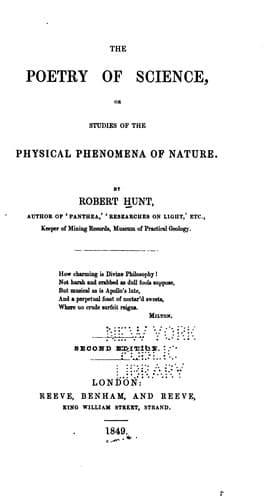
The Poetry of Science; or, Studies of the Physical Phenomena of NatureHunt, Robert
Philosophy
The Poetry of Science; or, Studies of the Physical Phenomena of Nature
Hunt, Robert
Physics; Science
These undulations, pulsations too refined for mortal ears, which
quicken and guide these wonderful organisms, may be indeed regarded
as sphered music for ever repeating the Divine command, “_Let there
be Light_,” by the creation of which, a dark and dreary chaos was
moulded into a star of beauty, capable of radiating brightness to other
space-wandering worlds.
FOOTNOTES:
[248] Percy Bysshe Shelley.
[249] _Experiments on the production of dephlogisticated air from water
with various substances_: by Lieut.-General Sir Benjamin, Count of
Rumford; Phil. Trans., vol. lxxvii. p. 84.
[250] _Experiments upon Vegetables, discovering their great power of
purifying the common air in the Sunshine, and of injuring it in the
Shade and at Night; to which is joined, A new method of examining the
accurate degrees of Salubrity of the Atmosphere_, by John Ingenhousz,
Councillor of the Court, and Body Physician to their Imperial and Royal
Majesties, F.R.S., &c. London: printed for P. Elmsley, in the Strand,
and H. Payne, Pall Mall, 1779.
[251] _The Kingdoms of Nature, their life and affinity_: by Dr. C. G.
Carus; Scientific Memoirs, vol. i. p. 223.
[252] In _Biologie_, by G. R. Treviranus, vol. ii. p. 302, the
following passage occurs:--“If we expose spring water to the sun in
open or even closed transparent vessels, after a few days bubbles
rise from the bottom, or from the sides of the vessel, and a green
crust is formed at the same time. Upon observing this crust through
a microscope, we discover a mass of green particles, generally of a
round or oval form, very minute, and overlaid with a transparent mucous
covering, some of them moving freely, whilst others, perfectly similar
to these, remain motionless and attached to the sides of the vessel.
This motion is sometimes greater than at others. The animalcules
frequently lie as if torpid, but soon recover their former activity.”
[253] _On the Structure of the Vegetable Cell_: by Mohl.--Scientific
Memoirs, vol. iv. p. 113. _Outlines of Structural and Physical Botany_:
by Henfrey.
[254] Dr. Carus, in the memoir already quoted, says:--“But since, in
the organization of the earth, light and air, as constituting a second
integrant part, stand opposed to gravitation, and since the plant
bears a relation, not only to gravitation, but to light also, when its
formation is complete it will necessarily present a second anatomical
system, namely, that of the spiral vessels, which have been very justly
considered, of late, as the organs that perform in plants the functions
of nerves.”
[255] Mr. Crosse’s Experiments in the Journal of the London Electrical
Society, and Mr. Weekes in the Electrical Magazine, and a communication
appended to _Explanations: a Sequel to the Vestiges of the Natural
History of Creation_.
[256] _Die Metamorphose der Pflanzen_: Goethe, sect. 78.
[257] Lindley’s _Elements of Botany_.
Public-domain text, read in full here on John Shaqi.
Reviews
Reviews
No reviews yet
Be the first to share your thoughts on this work.
Elsewhere in the archive
Join the Discussion
Join the discussion
Sign in to leave a comment or review.
Sign InorCreate an account