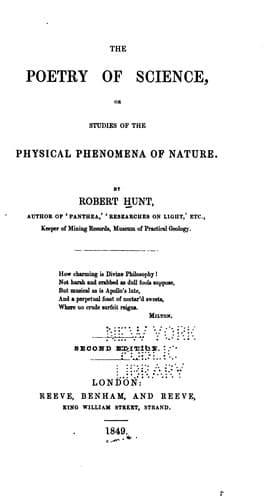
The Poetry of Science; or, Studies of the Physical Phenomena of NatureHunt, Robert
Philosophy
The Poetry of Science; or, Studies of the Physical Phenomena of Nature
Hunt, Robert
Physics; Science
Distinction between the Kingdoms of Nature--Progress of Animal
Life--Sponges--Polypes--Infusoria--Animalcula--Phosphorescent
Animals--Annelidans--Myriapoda--Animal
Metamorphoses--Fishes--Birds--Mammalia--Nervous System--Animal
Electricity--Chemical Influences--Influence of Light on Animal
Life--Animal Heat--Mechanical Action--Nervous Excitement--Man and
the Animal Races, &c.
“A stone grows; plants grow and live; animals grow, live, and feel.”
Such were the distinctions made by Linnæus, between the conditions
of the three kingdoms of nature. We cannot, however, but regard them
as in all respects illogical. The stone--a solid mass of unorganized
particles--enlarges, if placed in suitable conditions, by the accretion
of other similar particles around it; but it does not, according to any
meaning in which we use the word, _grow_. Plants and animals grow; and
they differ, probably, only in the phenomena of sensation. Yet, the
trembling mimosa, and several other plants, appear to possess as much
feeling as sponges and some of the lower classes of animals. By this
definition, however, of the celebrated Swedish naturalist, we have a
popular and simple expression of a great fact.
As we have only to examine the question of the agency of the physical
forces upon animal life, we must necessarily confine our attention to
the more striking phenomena with which science has made us acquainted;
and, having briefly traced the apparent order in which the advance of
organization proceeded, we must direct our few concluding remarks to
the physico-physiological influences, which we must confess to know but
too imperfectly.
We learn that, during the states of progress which geology, looking
into the arcana of time, has made us acquainted with, a great variety
of animal forms were brought into existence. They lived their periods.
The conditions of the surface of the earth, the sea, or the atmosphere,
were altered; and, no longer fitted for the enjoyments of the new life,
these races passed away, and others occupied their places, which, in
turn, went through all the stages of growth, maturity, and decay;
until at length, the earth being constituted for the abode of the
highest order of animals, they were called into existence; and man,
the intellectual monarch of the world, was placed supreme amongst them
all. Types of nearly all those forms of life which are found in the
fossil state are now in existence; and if we examine the geographical
distribution of animals--the zones of elevation over the surface of
the earth, and the zones of depth in the ocean,--we shall find, now
existing, animal creations strikingly analogous to the primitive forms
and conditions of the earth’s inhabitants. From the depths of the ocean
we may even now study--as that most indefatigable naturalist, Professor
Edward Forbes, has done--the varying states of organization under the
circumstances of imperfect light and varying temperature.[261]
Public-domain text, read in full here on John Shaqi.
Reviews
Reviews
No reviews yet
Be the first to share your thoughts on this work.
Elsewhere in the archive
Join the Discussion
Join the discussion
Sign in to leave a comment or review.
Sign InorCreate an account