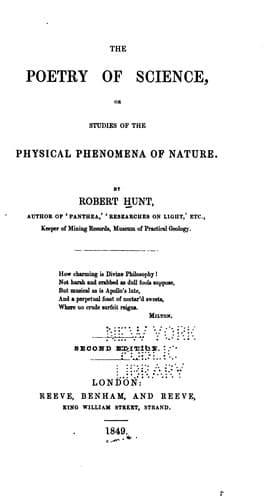
The Poetry of Science; or, Studies of the Physical Phenomena of NatureHunt, Robert
Philosophy
The Poetry of Science; or, Studies of the Physical Phenomena of Nature
Hunt, Robert
Physics; Science
Under the term molecular force, we include several agencies,--not
alike in the phenomena which they exhibit, but which are all-powerful
in producing the general characteristics of bodies. These require a
somewhat close examination. All the particles of even a solid mass may
be brought under conditions on which they are free to move. By heat we
can increase the length and thickness of a bar of iron, or any other
metal, and at length produce the fluid state,--a melted metal flows as
freely as water in a stream. Fluids, and gases in like manner obey the
dispersive influence of caloric. From these and other analogous results
we learn that all bodies have a greater or less degree of porosity.
The distance at which the particles of fluid bodies are maintained is
strikingly proved by the fact, that hydrated salts dissolved in water
occupy no more space than that which is equal to the water contained
in the crystalline body; while anhydrous salts dissolve without at
all increasing the bulk of the fluid. All the solid matter of the salt
must, in these cases, it would appear, go to fill up the interstitial
spaces which we suppose to exist in the liquid.[27]
The conditions which regulate the solubility of bodies, and the power
of solution, regarded either as a mechanical or a chemical process, are
very obscure. We might be led to suppose, that those bodies possessing
the largest amount of unoccupied space were capable of holding the
greatest quantity of soluble matter dissolved. This, however, is far
from being the case, the denser fluids generally having the greatest
solvent power.
The peculiar manner in which hydrogen gas appears to dissolve solid
substances,--as iron, potassium, sodium, sulphur, phosphorus,
selenium, and arsenic, may be explained by regarding the results as
a manifestation of the powers of chemical affinity over the forms of
bodies. In like manner, the solution of salt in water, or the mixture
of alcohol in that fluid, may be viewed as chemical phenomena, although
usually considered as simple cases of solution or mixture: alterations
of temperature and other physical changes taking place in either. If
two masses of metal,--either tin and copper, for example,--are melted
and combined, the united mass will not equal the bulk of the two
masses. If a pint measure of oil of vitriol and an equal quantity of
water are mixed together, the combined fluids will not fill a two pint
measure.[28]
Public-domain text, read in full here on John Shaqi.
Reviews
Reviews
No reviews yet
Be the first to share your thoughts on this work.
Join the Discussion
Join the discussion
Sign in to leave a comment or review.
Sign InorCreate an account