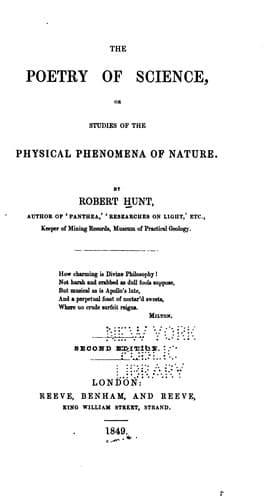
The Poetry of Science; or, Studies of the Physical Phenomena of NatureHunt, Robert
Philosophy
The Poetry of Science; or, Studies of the Physical Phenomena of Nature
Hunt, Robert
Physics; Science
[30] “In the annual report on the progress of chemistry, presented
to the Royal Academy of Stockholm, in March 1840, I have proposed to
designate by the term _allotropic state_, that dissimilar condition
which is observed in certain elements, and long known examples of which
are found in the different forms of carbon, as graphite and diamond.
“Although these dissimilar conditions, which I have here called
allotropic, have long since attracted attention in one or two elements,
still they have been regarded as exceptions to the general rule. It
is at present my object to show that they are not so rare; that it
is probably rather a general property of the elements to appear in
different allotropic conditions; and that although we have hitherto
been unable to obtain several of the elements when uncombined in
their allotropic states, still their compounds indicate the same with
tolerable distinctness.”--_Berzelius on the Allotropy of the Elementary
Bodies_, _&c._: Poggendorff’s Annalen, 1844. Scientific Memoirs, vol.
iv. p. 240.
[31] “Copper, when reduced by hydrogen at a heat below that of
redness, on exposure to air soon becomes converted throughout its
mass into protoxide; and when it is triturated for some time with
an equivalent quantity of sulphur, it combines with it according to
Böttcher’s experiments, producing flame, and forming sulphuret of
copper. If, however, the copper be reduced by hydrogen at a red heat,
still considerably below the temperature at which it softens and
begins to melt, it remains for years unchanged by exposure to air,
and cannot be made to combine with sulphur without the application of
heat. Iron, cobalt, and nickel, when reduced by hydrogen below a red
heat, inflame after they have cooled, if exposed to the air; and if
they are immediately placed in water to avoid their taking fire, they
inflame when they are again removed, and have become nearly dry. If we
compare this behaviour with that of iron reduced by heat, and with iron
in that state in which it forms the conductor of a galvanic current
without becoming oxidized, it would appear that these peculiarities
depended upon something more than a difference of mechanical
condition.”--_Berzelius on the Allotropy of Elementary Bodies._ See
_On the Isomeric Conditions of the Peroxide of Tin_: by Prof. H.
Rose.--Chemical Gazette, Oct. 1848.
[32] On this curious subject, and its history, see Bergman’s _Dissert.
de Phlog. quantitate in Metallis_, 1764. Kirwan, _On the Attractive
Powers of Mineral Acids_: Philosophical Transactions. Kier’s
_Experiments and Observations on the Dissolution of Metals in Acids_:
Phil. Trans. 1790.
Public-domain text, read in full here on John Shaqi.
Reviews
Reviews
No reviews yet
Be the first to share your thoughts on this work.
Join the Discussion
Join the discussion
Sign in to leave a comment or review.
Sign InorCreate an account