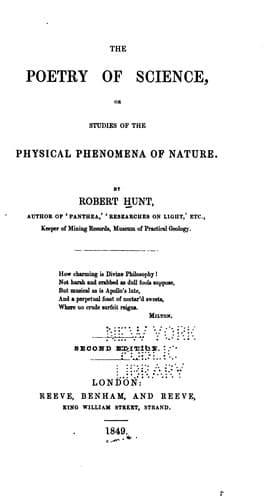
The Poetry of Science; or, Studies of the Physical Phenomena of NatureHunt, Robert
Philosophy
The Poetry of Science; or, Studies of the Physical Phenomena of Nature
Hunt, Robert
Physics; Science
From these valuable papers it will be seen that the peculiar states
of iron had already attracted attention, particularly those “inactive
conditions” noticed in a “_Note sur la Manière d’agir de l’Acide
nitrique sur le Fer, par J. F. W. Herschel_,” Aug. 1833; and previously
indicated by M. H. Braconnot, _Sur quelques Propriétés de l’Acide
nitrique_, Annales de Chimie, vol. lii. p. 54. Reference should also be
made to the Memoirs of Sir John Herschel, _On the Action of the Rays
of the Solar Spectrum on Vegetable Colours_, _&c._: Phil. Trans. vol.
cxxxiii. p. 221; and _On the Separation of Iron from other Metals_:
Phil. Trans. vol. cxi. p. 293; and several papers by Schönbein, in the
Philosophical Magazine, from 1837.
[33] Faraday, in his memoir _On new Magnetic Actions, and on the
Magnetic Conditions of all Matter_, says:--“By the exertion of this new
condition of force, the body moved may pass either along the magnetic
lines or across them, and it may move along or across them in either
or any direction, so that two portions of matter, simultaneously
subject to this power, may be made to approach each other as if they
were mutually attracted, or recede as if mutually repelled. All the
phenomena resolve themselves into this, that a portion of such matter,
when under magnetic action, tends to move from stronger to weaker
places or points of force. When the substance is surrounded by lines
of magnetic force of equal power on all sides, it does not tend to
move, and is then in marked contradistinction with a linear current of
electricity under the same circumstances.”--Phil. Trans. for 1846, vol.
cxxxvii.
[34] _New Experiments and Observations on Electricity made at
Philadelphia, in America._--Addressed to Mr. Collinson, from 1747
to 1754. By Benjamin Franklin. Of these Priestley remarks:--“It is
not easy to say whether we are most pleased with the simplicity and
perspicuity with which the author proposes every hypothesis of his own,
or the noble frankness with which he relates his mistakes, when they
were corrected by subsequent experiments.”
[35] “The atomic philosophy of Epicurus, in its mere physical
contemplation, allows of nothing but matter and space, which are
equally infinite and unbounded, which have equally existed from all
eternity, and from different combinations of which every visible form
is created. These elementary principles have no common property with
each other; for whatever matter is, that space is the reverse of; and
whatever space is, matter is the contrary to. The actual solid part of
all bodies, therefore, are matter, their actual pores space, and the
parts which are not altogether solid, but an intermixture of solidity
and pore, are space and matter combined.
Public-domain text, read in full here on John Shaqi.
Reviews
Reviews
No reviews yet
Be the first to share your thoughts on this work.
Elsewhere in the archive
Join the Discussion
Join the discussion
Sign in to leave a comment or review.
Sign InorCreate an account