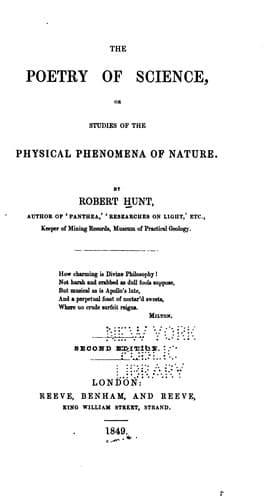
The Poetry of Science; or, Studies of the Physical Phenomena of NatureHunt, Robert
Philosophy
The Poetry of Science; or, Studies of the Physical Phenomena of Nature
Hunt, Robert
Physics; Science
“The infinite groups of atoms, flying through all time and space in
different directions and under different laws, have interchangeably
tried and exhibited every possible mode of rencounter: sometimes
repelled from each other by concussion, and sometimes adhering to each
other from their own jagged or pointed construction, or from the casual
interstices which two or more connected atoms must produce, and which
may be just adapted to those of other figures,--as globular, oval, or
square. Hence the origin of compound and visible bodies; hence the
origin of large masses of matter; hence, eventually, the origin of the
world itself.”--Dr. Good’s _Book of Nature_.
[36] Young’s _Lectures on Natural Philosophy and the Mechanical Arts_.
Lecture 49, _On the Essential Properties of Matter_.
CHAPTER V.
CRYSTALLOGENIC FORCES.
Crystallisation and Molecular Force distinguished--Experimental
Proof--Polarity of Particles forming a Crystal--Difference
between Organic and Inorganic Forms--Decomposition
of Crystals in Nature--Substitution of Particles in
Crystals--Pseudomorphism--Crystalline Form not dependent
on Chemical Nature--Isomorphism--Dimorphism--Theories of
Crystallogenic Attraction--Influence of Electricity and
Magnetism--Phenomena during Crystallisation--Can a change of
Form take place in Primitive Atoms?--Illustrative Example of
Crystallisation.
“Crystallisation is a peculiar and most admirable work of nature’s
geometry, worthy of being studied by all the power of genius, and the
whole energy of the mind, not on account of the delight which always
attends the knowledge of wonders, but because of its vast importance
in revealing to us the secrets of nature; for here she does, as it
were, betray herself, and, laying aside all disguise, permits us
to behold, not merely the results of her operations, but the very
processes themselves.”--Such is the language of an Italian philosopher,
Gulielmini; and it is the striking peculiarity of beholding the process
of the formation of the regular geometric figures of crystals, the
gradual accretion of particle to particle, which induces us to separate
crystallization from mere molecular aggregation. Without doubt the
formation of a crystal and the production of an amorphous block are
due to powers which bear a close resemblance in many points; but they
present remarkable differences in others.
Public-domain text, read in full here on John Shaqi.
Reviews
Reviews
No reviews yet
Be the first to share your thoughts on this work.
Elsewhere in the archive
Join the Discussion
Join the discussion
Sign in to leave a comment or review.
Sign InorCreate an account