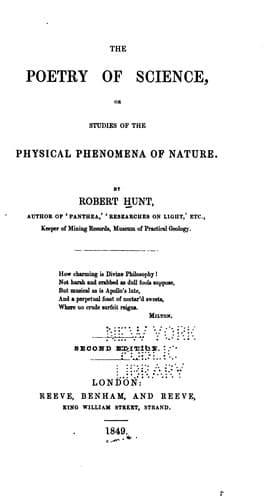
The Poetry of Science; or, Studies of the Physical Phenomena of NatureHunt, Robert
Philosophy
The Poetry of Science; or, Studies of the Physical Phenomena of Nature
Hunt, Robert
Physics; Science
THE PLANT _grows_, not by the gathering together of similar particles
of matter, but by the absorption of a compound particle--by that one
which must be regarded as the primary nuclear atom or cell. After
this absorption--in virtue of a power which we call LIFE, excited
into action by LIGHT--the compound particle is decomposed, and one
constituent is retained to effect the formation of a new cell, whilst
the other is liberated as an invisible air. Here we have a change of
chemical constitution effected; and this takes place through the whole
period of vegetable growth, from the development of the plumule up to
the formation of the latest leaf upon the topmost branch of the most
lordly tree.
Life has been referred to electricity and to chemical power--as the
effect of a known cause. Without doubt, during the operations of life
the whole of the physical powers are necessary to the production of
all the phenomena of growth in the vegetable and the animal world. But
these powers are ever subsidiary to vital force, and are like attendant
spirits chained to do an enchanter’s bidding.
Life is a force beyond the reach of human search, and he who fancies he
has a hold upon the principle which produced biological phenomena, has
committed himself to as wild a pursuit as he who rashly endeavours to
catch a morass-meteor.
Subtile as are the forces of light, heat, and electricity--that of
life, _vitality_, is infinitely more refined, and it must for ever
elude the search of the philosopher.
Man is permitted to test and try all things which are created, and
to apply to useful ends the discoveries which he may make. But man
can never become a creator; and he who would attempt to give sense to
an inert mass of matter, by electricity, heat, or light, will prove
himself as ignorant of nature’s truth as is the senseless mass upon
which he works.
“So far shalt thou go, and no further,” was said equally to the
great tide-wave of human intellect, as to the mighty surge of the
earth-girdling ocean.
It must not be forgotten that a striking difference exists between
the productions of the mineral and the other kingdoms of nature.
Animals and vegetables arrive at maturity by successive developments,
and increase by the assimilation of substances, having the power of
producing the most important chemical changes upon such matter as comes
within the range of their influence; but minerals are equally perfect
in the earliest stages of their formation, and increase only, as
previously said, by the accretion of particles without their undergoing
any change.
The animal and vegetable tribes cease to continue the functions of
life: death ensues, and a complete disorganisation takes place; but
this is not the case in the mineral world: the crystal being the result
of a constantly acting force is not necessarily liable to decomposition.
Public-domain text, read in full here on John Shaqi.
Reviews
Reviews
No reviews yet
Be the first to share your thoughts on this work.
Elsewhere in the archive
Join the Discussion
Join the discussion
Sign in to leave a comment or review.
Sign InorCreate an account