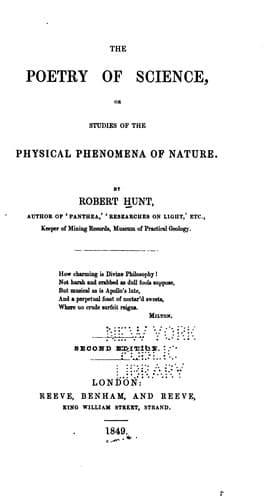
The Poetry of Science; or, Studies of the Physical Phenomena of NatureHunt, Robert
Philosophy
The Poetry of Science; or, Studies of the Physical Phenomena of Nature
Hunt, Robert
Physics; Science
Nevertheless, we sometimes find in nature that crystals, after arriving
at what may be regarded as, in some sort, their maturity, are, owing
to a change of the conditions under which they were formed, gradually
decomposed. In our mines we discover skeletons of crystals, and
within the hollow shell thus formed, other crystals of a different
constitution and figure find nuclei, and the conditions required for
their development. Again, to give a striking instance, the felspar
crystals of the granitic formations are liable to decomposition in a
somewhat peculiar manner. In decomposing, these crystals leave moulds
of their own peculiar forms, and it not unfrequently happens, in the
stanniferous districts of Cornwall, that oxide of tin gradually fills
these moulds, and we procure this metallic mineral in the form of the
earthy one. Then we have the curious instances of bodies crystallising
in a false form under change of circumstances. We find, for example,
Pseudomorphism, (or _false-form_), as this class of phenomena is named,
occurring by the removal of the constituent atoms of one crystal, while
another set--which naturally assumes a different form--takes their
place, yet still preserving the original shape. It often happens that
copper pyrites will, in this manner, exhibit the angles of an ordinary
variety of crystallised carbonate of iron. These curious changes may
be familiarised by supposing a beautiful statue of gold, from which
some skilful mechanic removes particle by particle, and so skilfully
substitutes a grain of brass for every one of gold removed, that the
loss of the precious metal cannot be detected by any mere examination
of its form.
Crystalline form is not strictly dependent upon the chemical nature
of the parts forming the crystal. The same number of atoms, arranged
in the same way, produce the same form. Substances much unlike each
other will assume the same crystalline arrangement. Magnesia, lime,
oxide of cadmium, the protoxides of iron, nickel, and cobalt, combined
with the same acid, present similarly formed bodies. These Isomorphic
(_like-form_)[37] peculiarities are exceedingly common, and the
discoverer of the phenomena, Mitscherlich, announced the above law.
It cannot, however, be regarded as a philosophical expression of the
fact, and requires reconsideration--chemical elements of a dissimilar
character may have the same law of aggregation, and thus produce the
same form, without having any relation to the number of atoms.
Public-domain text, read in full here on John Shaqi.
Reviews
Reviews
No reviews yet
Be the first to share your thoughts on this work.
Elsewhere in the archive
Join the Discussion
Join the discussion
Sign in to leave a comment or review.
Sign InorCreate an account