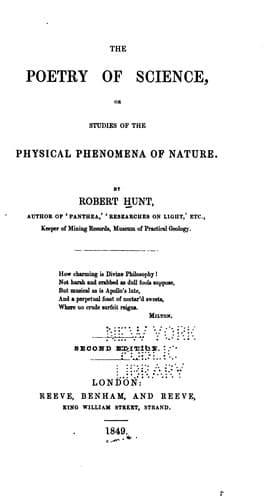
The Poetry of Science; or, Studies of the Physical Phenomena of NatureHunt, Robert
Philosophy
The Poetry of Science; or, Studies of the Physical Phenomena of Nature
Hunt, Robert
Physics; Science
Every substance, when placed under circumstances which allow of the
free movement of its molecules, has a tendency to crystallise. All the
metals may, by slowly cooling from the melting state, be exhibited
with a crystalline structure. Of the metallic and earthy minerals,
nature furnishes us with an almost infinite variety of crystals, and,
by a reduction of temperature, yet more simple bodies assume the
most symmetric forms. Water, in the conditions of ice and snow, is a
familiar and beautiful example; and, by such extreme degrees of cold as
are artificially produced, many of the gases exhibit a tendency to a
crystalline condition.
May not the solid elementary atoms be susceptible of change of form
under different influences? May not the different states under which
the same bodies are found--as, for example, silica, carbon, and
iron--be due entirely to a change in the form of the primitive atom?
Admitting the probability of this, we then easily see that the central
molecule, formed of an aggregation of such atoms, uniting by particular
faces, would present a determinate form; and that the resulting
crystal, a mass of such molecules, cohering according to a given law,
at certain angles, would present such geometric figures as we find in
nature, or produce in our laboratories, when we avail ourselves of
processes which nature has taught us.
If we take a particle of marble, and place it in a large quantity
of water acidulated with sulphuric acid, it dissolves, and a new
compound results. The marble disappears--the eye cannot detect it by
form or colour: the acid also has been disguised--the taste discovers
nothing sour in the fluid. We have, in combination with the water,
the lime and sulphuric acid; but that combination appears to the eye
in no respect different from the water itself. It is colourless and
perfectly transparent, although it holds a mass of solid matter which
previously would not allow of the permeation of a ray of light. Let
us expose this fluid to such circumstances that the water will slowly
evaporate, and we shall find forming in it, after a time, microscopic
particles of solid, light-refracting matter. These particles gradually
increase in size, and we may watch their growth until eventually we
have a symmetric figure, beautifully shaped, the primary form of
which is a right rhomboidal prism. Thus in nature, by the action,
in all probability, of vegetable matter on the sulphates held in
solution by the water of the great rivers and the ocean--aided by our
oxidizing atmosphere--sulphuric acid is produced to do its work upon
the limestone formations, and from this combination would result the
well-known gypsum, or plaster of Paris, which ordinarily exists as an
amorphous mass, but is often found in a crystalline form.[42]
Public-domain text, read in full here on John Shaqi.
Reviews
Reviews
No reviews yet
Be the first to share your thoughts on this work.
Elsewhere in the archive
Join the Discussion
Join the discussion
Sign in to leave a comment or review.
Sign InorCreate an account