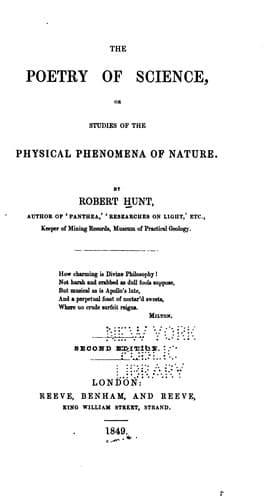
The Poetry of Science; or, Studies of the Physical Phenomena of NatureHunt, Robert
Philosophy
The Poetry of Science; or, Studies of the Physical Phenomena of Nature
Hunt, Robert
Physics; Science
Electricity, and light, and heat, exert remarkable powers, and
accelerate or retard crystallisation according to the conditions under
which these forces are brought to bear on the crystallising mass. We
have recently obtained evidence which appears to prove that some form
of magnetism has an active influence in determining the natural forms
of crystals, and we discover that magnetism exerts a peculiar influence
in relation to the optic axes of crystals, which is not exerted in
lines at right angles to these. Electricity appears to quicken the
process of crystalline aggregation--to collect more readily together
those atoms which seek to combine--to bring them all within the limits
of that influence by which their symmetrical forms are determined; and
strong evidence is now afforded, in support of the theory of magnetic
polarity, by the refined investigations of Faraday and Plücker, which
prove that magnetism has a _directing_ influence upon crystalline
bodies.[40]
It has been found that crystals of sulphate of iron, slowly forming
from a solution which has been placed within the range of sufficiently
powerful magnetic force, dispose themselves along certain magnetic
curves, such as are formed around a magnet by steel filings; whereas
the crystals of the Arbor Dianæ, or silver tree, forming under the
same circumstances, take a position nearly at right angles to these
curves. Certain groups of crystals have been found in nature, which
appear to show, by their positions, that terrestrial magnetism has been
active in producing the phenomena they exhibit; indeed, nearly all our
mineral formations indicate the influences of this, or some similarly
acting power.[41]
During rapid crystallisation, some salts--as the sulphate of
soda, boracic acid, and arsenious acid crystallising in muriatic
acid--exhibit decided indications of electrical excitement; light is
given out in flashes. We have evidence that crystals exhibit a tendency
to move towards the light, and that crystallisation takes place more
readily, and progresses with greater activity in the sunshine than in
the shade. Professor Plücker has recently ascertained that certain
crystals--in particular the cyanite--“point very well to the north,
by the magnetic power of the earth only. It is a true compass needle;
and, more than that, you may obtain its declination.” We must remember
that this crystal, the cyanite, is a compound of silica and alumina
only. This is the amount of experimental evidence which science has
afforded in explanation of the conditions under which nature pursues
her wondrous work of crystal formation. We see just sufficient of
the operation to be convinced that the luminous star which shines in
the brightness of Heaven, and the cavern-secreted gem, are equally
the result of forces which are known to us in only a few of their
modifications.
Public-domain text, read in full here on John Shaqi.
Reviews
Reviews
No reviews yet
Be the first to share your thoughts on this work.
Elsewhere in the archive
Join the Discussion
Join the discussion
Sign in to leave a comment or review.
Sign InorCreate an account