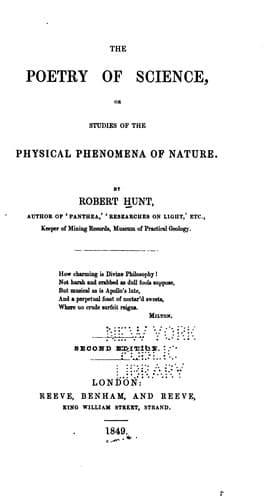
The Poetry of Science; or, Studies of the Physical Phenomena of NatureHunt, Robert
Philosophy
The Poetry of Science; or, Studies of the Physical Phenomena of Nature
Hunt, Robert
Physics; Science
[42] The transparent varieties of sulphate of lime are distinguished
by the name _Selenite_; and the fine massive varieties are called
_Alabaster_. Gypsum forms very extensive beds in secondary countries,
and is found in tertiary deposits; occasionally, in primitive rocks; it
is also a product of volcanoes. The finest foreign specimens are found
in the salt mines of Bex, in Switzerland; at Hall, in the Tyrol; in the
sulphur-mines of Sicily; and in the gypsum formation near Ocana, in
Spain. In England, the clay of Shotover Hill, near Oxford, yields the
largest crystals.--See Dana’s _Mineralogy_, second edition, p. 241.
CHAPTER VI.
HEAT--SOLAR AND TERRESTRIAL.
Solar and Terrestrial Heat--Position of the Earth in the Solar
System--Heat and Light associated in the Sunbeam--Transparency
of Bodies to Heat--Heating Powers of the Coloured Rays of
the Spectrum--Undulatory Theory--Conducting Property of the
Earth’s Crust--Convection--Radiation--Action of the Atmosphere
on Heat Rays--Peculiar Heat Rays--Absorption and Radiation
of Heat by dissimilar Bodies--Changes in the Constitution of
Solar Beam--Differences between Transmitted and Reflected
Solar Heat--Phenomena of Dew--Action of Solar Heat on the
Ocean--Circulation of Heat by the Atmosphere and the Ocean--Heat
of the Earth--Mean Temperature--Central Heat--Constant Radiation
of Heat Rays from all Bodies--Thermography--Action of Heat on
Molecular Arrangements--Sources of Terrestrial Heat--Latent
Heat of Bodies--Animal Heat--Eremacausis--Spheroidal State
Cold--Condensation--Freezing--Theories of Heat--Natural
Phenomena--and Philosophical Conclusion.
We receive heat from the sun, associated with light; and we have the
power of developing this important principle by physical, mechanical,
and chemical excitation, from every kind of matter. Our convictions
are, that the calorific element, whether derived from a solar or a
terrestrial source, presents no essential difference in its physical
characters; but as there are some remarkable peculiarities in the
phenomena, as they arise from either one or the other source, it will
assist our comprehension of this great principle, if we consider it
under the two heads.
Untutored man finds health and gladness in the warmth and light of the
sun; he rears a rugged altar, and bows his soul in prayer, to the
principle of fire, which in his ignorance he regards as the giver and
the supporter of life. The philosopher finds life and organization
dependent upon the powers combined in the sunbeam; and, examining
the phenomena of this wonderful band of forces, he is compelled to
acknowledge that the flame upon the altar--on the Persian hills,--was
indeed a dim shadow of the infinite wisdom which abides behind the veil.
Public-domain text, read in full here on John Shaqi.
Reviews
Reviews
No reviews yet
Be the first to share your thoughts on this work.
Elsewhere in the archive
Join the Discussion
Join the discussion
Sign in to leave a comment or review.
Sign InorCreate an account