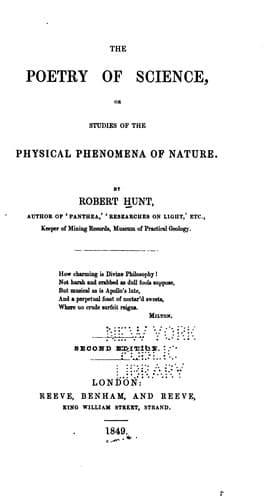
The Poetry of Science; or, Studies of the Physical Phenomena of NatureHunt, Robert
Philosophy
The Poetry of Science; or, Studies of the Physical Phenomena of Nature
Hunt, Robert
Physics; Science
The present condition of our earth is directly dependent upon the
amount of heat we receive from the sun. It has frequently been said,
that if it were possible to move this planet so much nearer that orb
that the quantity of heat would be increased, the circumstances of
life would necessarily be so far changed, that all the present races
of animals must perish; and that the same result would happen from
any alteration which threw us yet further from our central luminary,
when, owing to the extremity of cold and the wretchedness of gloom, all
living creatures would equally fail to support their organization.
To move the earth nearer to, or more distant from the sun, is an
impossibility; but it has been argued that those planets which are near
to the sun must possess a temperature which would melt our solid rocks,
and vaporize the ocean,--while Uranus and Neptune must, from their
distance from the source of heat, have so small an amount, that water
must become solid as the rock, and such an atmosphere as that of the
earth exist as a dense liquid.
It will be shown that according to the physical condition of the
material substances, so are their powers regulated of absorbing and
retaining the heat which falls as a radiant power upon their surfaces.
Heat rays, in passing through the attenuated medium of planetary space,
lose none of their power--this we know from the fact that even the less
dense upper region of the earth’s atmosphere takes from the solar rays
but an exceedingly small quantity of heat. Therefore, whether a solar
heat ray traverses through one million, or one hundred million miles of
space, it still retains its power equally of imparting warmth to the
solid matter by which it is intercepted. There is no law of variation
as the inverse square of the distance of those radiating powers.
Consequently, there is no reason why the physical conditions, alike
of the nearest and the most remote planetary bodies, should not be so
adjusted that they all enjoy that life promoting temperature which
belongs to the earth.
All the objects around us are adapted to the circumstances of the
earth’s position in relation to the sun, to which we are bound by the
principle of gravitation; opposed to that centrifugal force which tends
constantly to drive the moving planetary mass off from the centre of
power. The balance maintains its perfect equilibrium, although we have
one power constantly drawing the earth towards the sun, and the other
as constantly exerting itself to move it off into space at a tangent
to the orbit in which the planet moves. In our examination it will be
found that one common system of harmony runs through all the cosmical
phenomena, by which everything is produced that is so beautiful and
joyous in this world.
Public-domain text, read in full here on John Shaqi.
Reviews
Reviews
No reviews yet
Be the first to share your thoughts on this work.
Elsewhere in the archive
Join the Discussion
Join the discussion
Sign in to leave a comment or review.
Sign InorCreate an account