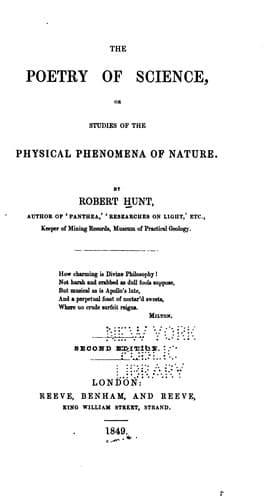
The Poetry of Science; or, Studies of the Physical Phenomena of NatureHunt, Robert
Philosophy
The Poetry of Science; or, Studies of the Physical Phenomena of Nature
Hunt, Robert
Physics; Science
The beautiful phenomenon of the formation of dew is also distinctly
connected with the peculiar properties which we have been studying.
When from the bright blue vault of heaven, the sparkling constellations
shower their mild light over the earth, the flowers of the garden
and the leaves of the forest become moist with a fluid of the most
translucid nature. Well might the ancients imagine that the dews were
actually shed from the stars; and the alchemists and physicians of the
middle ages conceive that this pure distillation of the night possessed
subtile and penetrating powers beyond most other things; and the
ladies of those olden times endeavour to preserve their charms in the
perfection of their youthful beauty through the influences of washes
procured from so pure a source.[53]
Science has removed the veil of mystery with which superstition had
invested the formation of dew; and, in showing to us that it is
a condensation of vapour upon bodies according to a fixed law of
radiation, it has also developed so many remarkable facts connected
with the characters of material creations, that a much higher order of
poetry is opened to the mind than that which, though beautiful, sprang
merely from the imagination.
Upon the radiation of heat depends the formation of dew, and bodies
must become colder than the atmosphere before it will be deposited
upon them. At whatever temperature the air may be, it is charged to
saturation with watery vapour, the quantity varying uniformly with
the temperature. Supposing the temperature of the air to be 70° F.,
and that a bottle of water at 60° is placed in it, the air around
the bottle will be cooled, and will deposit on the glass exactly
that quantity of moisture which is due to the difference between the
temperature of the two bodies. Different substances, independent of
colour, have the property of parting with heat from their surfaces at
different rates. Rough and porous surfaces radiate heat more rapidly
than smooth ones, and are consequently reduced in temperature; and, if
exposed, are covered with dew sooner than such as are smooth and dense.
The grass parterre glistens with dew, whilst the hard and stony walk is
unmoistened.[54]
Public-domain text, read in full here on John Shaqi.
Reviews
Reviews
No reviews yet
Be the first to share your thoughts on this work.
Elsewhere in the archive
Join the Discussion
Join the discussion
Sign in to leave a comment or review.
Sign InorCreate an account