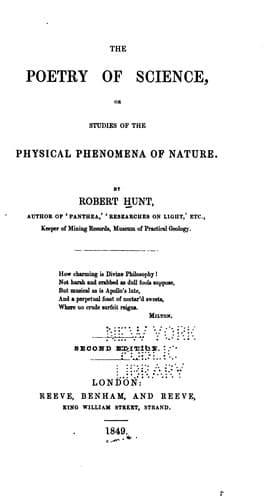
The Poetry of Science; or, Studies of the Physical Phenomena of NatureHunt, Robert
Philosophy
The Poetry of Science; or, Studies of the Physical Phenomena of Nature
Hunt, Robert
Physics; Science
A combination of the two gases, chlorine and oxygen, becomes solid at
-75°, and the protoxide of nitrogen at -150°. Cyanogen, a compound
of carbon and nitrogen--the base of prussic acid--is solidified at
30° below the zero of our thermometric scale. The well-known pungent
compound, ammonia, so exceedingly volatile at common temperatures,
is converted into a crystalline, translucent, white substance at the
temperature of -103°. The difficulties which necessarily attend the
exposure of a body to extreme cold and great pressure at the same time,
appear to be the only obstacle to the condensation of oxygen, hydrogen,
and nitrogen gases. A sufficient amount of condensation was, however,
effected by Dr. Faraday, to lead him to the conclusion, arrived at
also by other evidences, that hydrogen, the lightest of the ponderable
bodies, partakes of the nature of a metal.[82]
During the solidification of water by freezing, some remarkable facts
may be noticed.
Water, in cooling, gradually condenses in volume until it arrives at
40° Fahr., which appears to be the point of greatest density. From this
temperature to that of 32°, the point at which it begins to solidify,
its volume remains unchanged,[82] as crystallisation (freezing) begins,
the bulk increases, the mass becomes specifically lighter, and it swims
on the surface of the fluid. From 40° to 32° the particles of water
must be taking up that new position which is essential to the formation
of the solid--ice; and while this is taking place, every substance held
in solution by the water is rejected.
If we mix with water the deepest colouring matter--the strongest acid
or the most acrid poison--they are each and all rejected during the
process of freezing, and if the water has been kept in a state of
agitation during the process--so that the liberated particles may not
be mechanically entangled--the ice will be transparent, colourless,
tasteless, and inert--the substances rejected being gathered together
in the centre of the frozen mass in a state of intense concentration.
In like manner, even the atmospheric air, which is always held in
solution, is rejected, and hence the reason why all the ice which
forms upon still ponds is full of air-bubbles, while the ice which is
produced in agitated water is perfectly free from them. This in itself
is a remarkable condition, the entire bearing of which is not clearly
understood; but a still more singular fact has been discovered in
intimate connection with the rejection of all matter from a freezing
solution. Water, which in this way is freed entirely of air, will not
boil at 212° F., the ordinary boiling point of water.
Public-domain text, read in full here on John Shaqi.
Reviews
Reviews
No reviews yet
Be the first to share your thoughts on this work.
Elsewhere in the archive
Join the Discussion
Join the discussion
Sign in to leave a comment or review.
Sign InorCreate an account