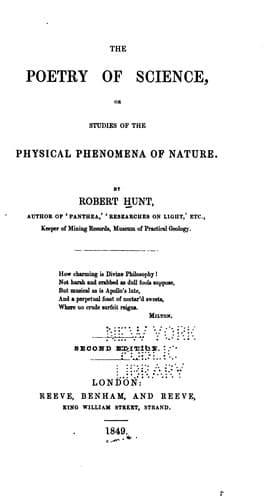
The Poetry of Science; or, Studies of the Physical Phenomena of NatureHunt, Robert
Philosophy
The Poetry of Science; or, Studies of the Physical Phenomena of Nature
Hunt, Robert
Physics; Science
All we know of heat is, that striking effects are produced which we
measure by sensation, and by instruments upon which we have observed
that given results will be produced under certain conditions: of
anything approaching to the cause of these we are totally ignorant.
The wonder-working mover of some of the grandest phenomena in
nature--giving health to the organic world, and form to the inorganic
mass--producing genial gales and dire tornadoes--earthquake strugglings
and volcanic eruptions--ministering to our comforts in the homely fire,
and to advancement in civilisation in the mighty furnace, and the
ingenious engine which drains our mines, or traverses our country with
bird-like speed,--will, in all probability, remain for ever unknown to
man. The immortal Newton, many of whose guesses have a prophetic value,
thus expresses himself:--“Heat consists in a minute vibratory motion in
the particles of bodies, and this motion is communicated through an
apparent vacuum by the undulations of a very subtile elastic medium,
which is also concerned in the phenomena of light.”
Our experimental labours and our mathematical investigations have
considerably advanced our knowledge since the time of Newton; yet still
each theory of heat strangely resembles the mystic lamp which the
Rosicrucian regarded as a type of eternal life--a dim and flickering
symbol, in the tongue-like flame of which imagination, like a child,
can conjure many shapes.
Modern theory regards heat as a manifestation of motion, and experiment
proves that a body falling through a certain space generates a definite
quantity of heat, while observation shows that the waters at the base
of the Falls of Niagara possess a temperature 1° higher than when they
first glide over the edge of the precipice.
This increase of temperature is due to the mechanical force due to
the fall, and is no more an evidence of the conversion of motion into
heat, than is the old experiment of rubbing a button until it becomes
hot. At all events, the fact that a given amount of mechanical force
always produces an equivalent of heat is as applicable to the idea of
a “subtile elastic medium” which is diffused through all matter, as to
the, at present, favourite hypothesis.
So far has this view been strained, that the temperature of the planets
has been referred to their motions, and speculation has aided the
mathematician in determining the cessation of planetary motion, by
the conversion of it into heat. It is true that other theorists have
supposed points in space upon which this heat might be concentrated and
reflected back again to produce motion.
There may be much of the poetic element in such speculations, but it is
of that order which belongs rather to the romantic than to the real.
A speculation which has more of truth, and which is, indeed,
demonstrable, cannot fail to impress every mind with its beauty, and
probable correctness.
Public-domain text, read in full here on John Shaqi.
Reviews
Reviews
No reviews yet
Be the first to share your thoughts on this work.
Elsewhere in the archive
Join the Discussion
Join the discussion
Sign in to leave a comment or review.
Sign InorCreate an account