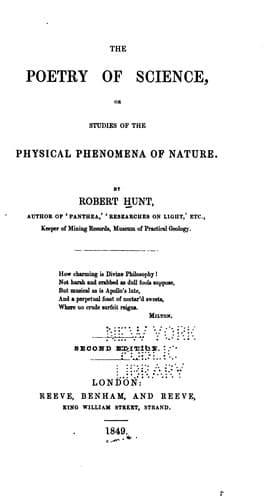
The Poetry of Science; or, Studies of the Physical Phenomena of NatureHunt, Robert
Philosophy
The Poetry of Science; or, Studies of the Physical Phenomena of Nature
Hunt, Robert
Physics; Science
Reference should also be made to a paper by Dr. Robinson, _On the
effects of Heat in lessening the Affinities of the Elements of Water_,
in the Transactions of the Royal Irish Academy, 1848, where he says
that “when a platinum wire is traversed by a current gradually
increased till it produces ignition, the first gleam that appears is
not red, but of a colour which, when I first saw it, I compared to
the ‘lavender ray’ discovered by Sir John Herschel beyond the violet,
though I was surprised at seeing the tint of that most refrangible ray
preceding the ray which is least so. It is quite conspicuous at about
865°; and as the mode in which it makes its appearance presents nothing
abrupt or discontinuous, it seems likely that it is merely a transition
from invisible rays excited at a lower temperature to ordinary
light.”--p. 310.
[47] In the _Bakerian Lecture_ for 1842, _On the transparency of the
Atmosphere, and the law of extinction of the solar rays in passing
through it_, by James D. Forbes, Esq., F.R.S., &c., will be found a
most complete investigation of this subject.
The experiments were, for the most part, made in Switzerland with Sir
John Herschel’s actinometer, and they prove satisfactorily,--“That
the absorption of the solar rays by the strata of air to which we
have immediate access, is considerable in amount for even moderate
thicknesses.”
[48] After referring to several curious and instructive experiments, in
which peculiar chemical changes are produced under the influence of the
solar rays by their HEAT, Sir John Herschel says:--
“These rays are distinguished from those of Light by being invisible;
they are also distinguished from the pure calorific rays beyond the
spectrum, by their possessing properties (_of a peculiar character,
referred to in former papers_) either exclusively of the calorific
rays, or in a much higher degree. They may perhaps not improperly be
regarded as bearing the same relation to the calorific spectrum which
the photographic rays do to the luminous ones. If the restriction
to these rays of the term _thermic_, as distinct from _calorific_,
be not (as I think, in fact, it is not) a sufficient distinction, I
would propose the term _parathermic rays_ to designate them. These are
the rays which I conceive to be active in producing those singular
molecular affections which determine the precipitation of vapours in
the experiments of Messrs. Draper, Moser, and Hunt, and which will
probably lead to important discoveries as to the intimate nature of
those forces resident on the surfaces of bodies, to which M. Dutrochet
has given the name of epipolic forces.”--_On certain improvements in
Photographic Processes, described in a former communication_ (Phil.
Trans, vol. cxxxiii.); and _On the Parathermic Rays of the Solar
Spectrum_, Phil. Trans, vol. cxxxiv.
Public-domain text, read in full here on John Shaqi.
Reviews
Reviews
No reviews yet
Be the first to share your thoughts on this work.
Elsewhere in the archive
Join the Discussion
Join the discussion
Sign in to leave a comment or review.
Sign InorCreate an account