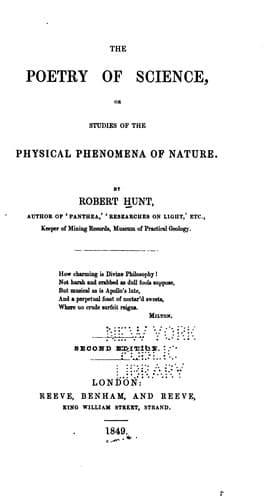
The Poetry of Science; or, Studies of the Physical Phenomena of NatureHunt, Robert
Philosophy
The Poetry of Science; or, Studies of the Physical Phenomena of Nature
Hunt, Robert
Physics; Science
[64] Sir David Brewster differs from the conclusions arrived at by
Delaroche. He thus explains his views:--“The inability of radiant
heat to pass through glass, may be considered as a consequence of its
refusing to yield to the refractive force; for we can scarcely conceive
a particle of radiant matter freely permeating a solid body, without
suffering some change in its velocity and direction. The ingenious
experiments of M. Prévost, of Geneva, and the more recent ones of
M. Delaroche, have been considered as establishing the permeability
of glass to radiant heat. M. Prévost employed moveable screens of
glass, and renewed them continually, in order that the result which
he obtained might not be ascribed to the heating of the screen; but
such is the rapidity with which heat is propagated through a thin
plate of glass, that it is extremely difficult, if not impossible, to
observe the state of the thermometer before it has been affected by
the secondary radiation from the screen. The method employed by M.
Delaroche, of observing the difference of effect, when a blackened
glass screen and a transparent one were made successively to intercept
the radiant heat, is liable to an obvious error. The radiant heat would
find a quicker passage through the transparent screen; and, therefore,
the difference of effect was not due to the transmitted heat, but to
the heat radiated from the anterior surface. The truth contained in M.
Delaroche’s fifth proposition is almost a demonstration of the fallacy
of all those that precede it. He found that ‘a thick plate of glass,
though as much or more permeable to light than a thin glass of worse
quality, allowed a much smaller quantity of radiant heat to pass.’ If
he had employed very thick plates of the purest flint glass, or thick
masses of fluid that have the power of transmitting light copiously,
he would have found that not a single particle of heat was capable of
passing directly through transparent media.”--Sir D. Brewster, _On new
properties of heat as exhibited in its propagation along plates of
glass_. Philosophical Transactions, vol. cvi. p. 107.
[65] _Proposal of a New Nomenclature for the Science of Calorific
Radiations_, by M. Melloni. Bibliothèque Universelle de Genève, No.
70. Scientific Memoirs, vol. iii. part 12. Many of the terms, as
_Diathermasy_, or transparency for heat; _Adiathermasy_, opacity for
heat; _Thermochroic_, coloured for heat, and others, are valuable
suggestions of forms of expression which are required in dealing with
these physical phenomena.
Public-domain text, read in full here on John Shaqi.
Reviews
Reviews
No reviews yet
Be the first to share your thoughts on this work.
Elsewhere in the archive
Join the Discussion
Join the discussion
Sign in to leave a comment or review.
Sign InorCreate an account