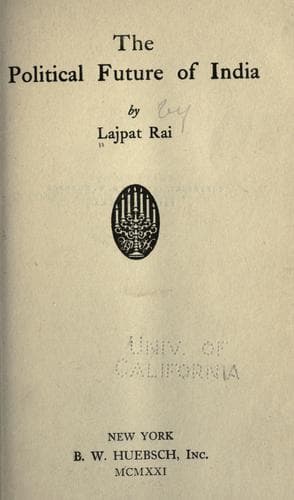
India -- History -- British occupation, 1765-1947; India -- Politics and government -- 1765-1947
Equally misleading is the last sentence of the introduction where the
committee says that it is among the Chitpavan Brahmins of the Poona
district that they first find indications of a revolutionary movement.
This statement is incorrect, if it means that after the establishment of
British rule in India no attempt had been made to overthrow it prior to
the Revolutionary movement inaugurated by the Poona Brahmins. The
statement ignores three such attempts which are known to history; viz.,
(_a_) the great Mutiny of 1857, (_b_) the Wahábee Rebellion of Bengal,
and (_c_) the Kúká Rebellion of the Punjab; not to mention other minor
attempts made in other places by other people.
Yet we think that this report is a very valuable document, giving in one
place the history and the progress of the Revolutionary Movement in
India. The findings and the recommendations of the committee may not be
all correct, but the material collected and published for the first time
is too valuable to be neglected by anyone who wants to have an
intelligent grasp of the political situation in India, such as has
developed within the last twenty years.
The committee gives a summary of its conclusions as to the conspiracies
in Chapter XV, which we copy verbatim:
"In Bombay they have been purely Brahmin and mostly Chitpavan. In
Bengal the conspirators have been young men belonging to the
educated middle classes. Their propaganda has been elaborate,
persistent and ingenious. In their own province it has produced a
long series of murders and robberies. In Bihar and Orissa, the
United Provinces, the Central Provinces and Madras, it took no
root, but occasionally led to crime and disorder. In the Punjab
the return of emigrants from America, bent on revolution and
bloodshed, produced numerous outrages and the _Ghadr_ conspiracy
of 1915. In Burma, too, the _Ghadr_ movement was active, but was
arrested.
"Finally came a Mohammedan conspiracy confined to a small clique
of fanatics and designed to overthrow British rule with foreign
aid.
"All these plots have been directed towards one and the same
objective, the overthrow by force of British rule in India.
Sometimes they have been isolated; sometimes they have been
interconnected; sometimes they have been encouraged and supported
by German influence. All have been successfully encountered with
the support of Indian loyalty."
In this general summary the committee has made no attempt to trace out
the causes that led to the inauguration of the revolutionary movement
and its subsequent progress. A chapter on that subject would have been
most illuminating.
In chapters dealing with provinces they have selected some individuals
and classes on whom to lay blame for "incitements" to murders and
crimes, but have entirely failed to analyze the social, political and
economic conditions which made such incitements and their success
possible.
Public-domain text, read in full here on John Shaqi.
Reviews
Reviews
No reviews yet
Be the first to share your thoughts on this work.
Elsewhere in the archive
Join the Discussion
Join the discussion
Sign in to leave a comment or review.
Sign InorCreate an account