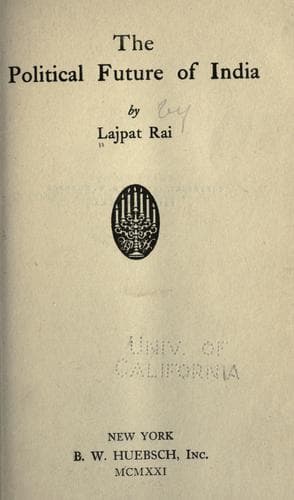
India -- History -- British occupation, 1765-1947; India -- Politics and government -- 1765-1947
The Sikhs and the Mussulmans of the Punjab, as well as the military
classes among the Hindus, the Rajputs and the Jats, are the most virile
portions of the population. They have fought the battles of the Empire.
In the interests of the Empire they have travelled far and wide. Yet we
find that educationally, as well as economically, they have suffered
most. They have the largest numbers of illiterates among them. They are
the least developed and the least progressive of all the classes in the
Punjab. They are heavily in debt. The Government has occasionally
recognised it and has tried to satisfy them by preferential treatment
in the filling of Government posts, or in the bestowal of titles or in
nominating their supposed leaders to Legislative Councils. These
ridiculous palliative measures, however, have failed in their objective.
The classes disaffected do not get any satisfaction by these palliative
measures. They need opportunities of education and economic betterment.
These could not be provided without making education general and without
a more equitable distribution of land among the agricultural classes and
the inauguration of industries other than agriculture. This the
Government never cared to do. The Sikhs and the Mussulmans naturally
directed their attention to emigration.
The opportunities they found in other parts of the Empire whetted their
appetites. They compared the conditions abroad with conditions at home
and drew their own conclusions. Having helped in the expansion and
development of the Empire they thought they were entitled to benefit
therefrom. They demanded fair treatment. Instead they found the doors
shut upon them. Even those that had been admitted were made to feel the
humiliation of their position. Deliberate, active, concerted measures
were taken to drive them away or to make life for them intolerable.
Their wives and children were refused admittance and various pretexts
were invented to keep them out or to drive them away. The revolutionary
movement in the Punjab amounted to nothing until it was reinforced by
the return of the Sikh members of the Ghadr party during the war. The
Committee has failed to answer the question: Why did the Sikhs of
Vancouver and California readily fall in with the schemes of Hardayal
and Barkat Ullah, the alleged founders of the revolutionary party of
California? These latter had nothing in common with the Sikhs. In
language and religion, by habits and associations, they were poles apart
from each other. Why did then Hardayal's propaganda find such a ready
soil among the Sikhs of Vancouver B. C. We quote from the report:
Public-domain text, read in full here on John Shaqi.
Reviews
Reviews
No reviews yet
Be the first to share your thoughts on this work.
Elsewhere in the archive
Join the Discussion
Join the discussion
Sign in to leave a comment or review.
Sign InorCreate an account