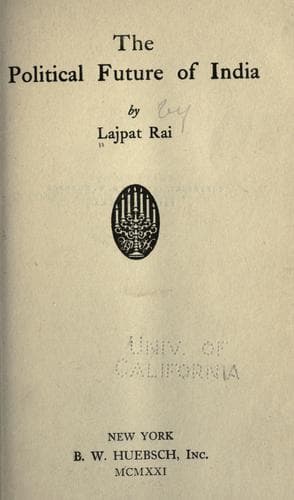
India -- History -- British occupation, 1765-1947; India -- Politics and government -- 1765-1947
Existing Temporary Powers. The powers at present temporarily
possessed by the Government are so far as material for the present
purpose to be found in rules 3-7 inclusive and 12A under the
Defence of India Act, 1915. We do not refer for the present to
the Foreigners Ordinance, 1914, or the Ingress into India
Ordinance, 1914.... Shortly stated, their effect is to give power
to require persons by executive order to remain in any area to be
specified or not to enter or remain in any such area, with
penalties for breach of such requirements. These orders may be
made and served on the person affected, whereupon they become
binding upon him, or the person may be arrested without warrant
and detained for a period not exceeding in all one month, pending
an order of restriction. There is also a power of search under
search warrant. It will be observed there is no provision for an
examination of the cases of such persons. The decision lies solely
with the Local Government. There is also the power of confinement
under Regulation III of 1818.
Again:
"Two Grades of Powers Desirable.--We now proceed to elaborate ...
the scheme we suggest.
"We think, as we have already indicated, that the powers to be
acquired should be of two grades capable of being called into
operation separately, possibly under different forms of
notification.
"The first group of powers should be of the following nature:--
"(i) to demand security with or without sureties;
"(ii) to restrict residence or to require notification of change
of residence;
"(iii) to require abstention from certain acts, such as engaging
in journalism, distributing leaflets or attending meetings;
"(iv) to require that the person should periodically report to the
police.
"The second group of powers should be--
"(i) to arrest;
"(ii) to search under warrant;
"(iii) to confine in non-penal custody.
"In Article 196 they provide "that in respect of acts committed before
the Defence of India Act expires (or an earlier date if preferred) and
danger apprehended by reason of such acts in the future it should be
lawful to proceed against any person under any of the provisions which
we have outlined without any notification. In other words, the new law
is to be deemed to be operative for that purpose immediately."
Articles 198 and 199 suggest measures for restricting "Ingress into
India" and also for regulating and restricting "Inter-Provincial
Movements."
Need it be said that if these recommendations are accepted there will be
no liberty of press or speech in India and the Reform will fail to
suppress the revolutionary movement at all. Indian opinion is unanimous
in condemning these recommendations as has been proved by the unanimous
opposition of all sections of Indians in the Viceroy's Legislative
Council to the bills that have been introduced to give effect to them.
Public-domain text, read in full here on John Shaqi.
Reviews
Reviews
No reviews yet
Be the first to share your thoughts on this work.
Elsewhere in the archive
Join the Discussion
Join the discussion
Sign in to leave a comment or review.
Sign InorCreate an account