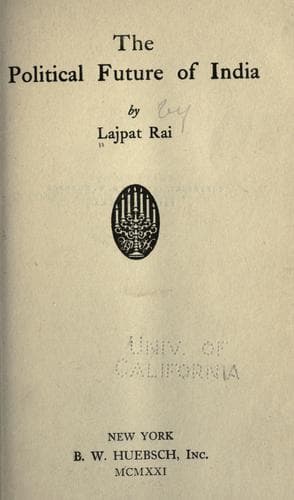
India -- History -- British occupation, 1765-1947; India -- Politics and government -- 1765-1947
"From the economic point of view India had been handicapped by the
want of professional and technical instruction: her colleges turn
out numbers of young men qualified for Government clerkships while
the real interests of the country require, for example, doctors
and engineers in excess of the existing supply. The charge that
Government has produced a large _intelligentsia_ which cannot find
employment has much substance in it: it is one of the facts that
lie at the root of recent political difficulties. But it is only
of late years and as part of the remarkable awakening of national
self-consciousness, that the complaint has been heard that the
system has failed to train Indians for practical work in
manufactures, commerce, and the application of science to
industrial life."
After making a few general observations on the so called difficulties in
the way of a general spread of education "the chief needs at present"
are thus pointed out:
"Primary education, as we have seen, is already practically in the
hands of local bodies, but secondary education was deliberately
left at the outset almost entirely to private agencies. The
universities, despite their connection with Government, are
largely non-official bodies with extensive powers.[1] The main
defect of the system is probably the want of co-ordination between
primary and higher education, which in turn reacts upon the
efficiency of the secondary institutions and to a great extent
confines university colleges to the unsatisfactory function of
mere finishing schools. The universities have suffered from having
been allowed to drift into the position of institutions that are
expected not so much to educate in the true sense as to provide
the student with the means of entering an official or a
professional career. Thus a high percentage of failures seems to a
large body of Indian opinion not so much a proof of the faultiness
of the methods of teaching as an example of an almost capricious
refusal of the means of obtaining a living wage to boys who have
worked for years often at the cost of real hardship to secure an
independent livelihood. The educational wastage is everywhere
excessive; and analysis shows that it is largely due to
under-payment and want of proper training in the case of teachers.
The actual recruits for normal schools are too often ill-prepared,
and the teaching career, which in India used formerly to command
respect, does not now offer adequate inducements to men of ability
and force of character. The first need, therefore, is the
improvement of teaching. Until that is attained it is vain to
expect that the continuation of studies from the primary stage can
be made attractive. But while the improvement of primary and
middle schools is the first step to be taken, very much remains to
Public-domain text, read in full here on John Shaqi.
Reviews
Reviews
No reviews yet
Be the first to share your thoughts on this work.
Elsewhere in the archive
Join the Discussion
Join the discussion
Sign in to leave a comment or review.
Sign InorCreate an account