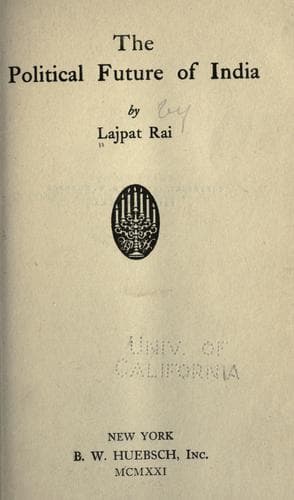
India -- History -- British occupation, 1765-1947; India -- Politics and government -- 1765-1947
[1] We do not accept this statement. The Government controls the policy
of the universities to such an extent as virtually to make them official
institutions.
[2] National Education in India.
XVII
THE PROBLEM
We have so far discussed the Report and such remarks as we have made
have been by way of comment. In this chapter we propose to give in brief
outline our own view of the problem.
Let us first be clear about the exact nature of the Indian problem.
Political institutions are, after all, only a reflection of the national
mind and of national conditions. What is the end? The end is freedom to
live and to live according to our own conception of what life should be,
to pursue our own ideals, to develop our own civilization and to secure
that unity of purpose which would distinguish us from the other nations
of the world, insuring for us a position of independence and honor, of
security from within and non-interference from without. We have no
ambition to conquer and rule other peoples; we have no desire to exploit
foreign markets; not even to impose our "kultur" and our "civilization"
on others. At present we are counted among the backward peoples of the
earth mainly because we are a subject people, governed by a foreign
power, protected by foreign bayonets and schooled by foreign teachers.
The condition of our masses is intellectually deplorable and
economically miserable; our women are still in bondage and do not enjoy
that freedom which their Western sisters have won; our domestic
masters, the prince and priest, are still in saddle; caste and privilege
still hold some sway, yet it is not true that, taken all in all, we are
really a backward people. Even in these matters we find that the
difference between us and the "advanced" nations of the world is one of
degree only. Caste and privilege rule in the United States as much as in
India. There is nothing in our history which can be put on the same
level as the lynching of Mr. Little, the deportation of Bisbee miners,
the lynching of the Negroes, and other incidents of a similar nature
indicative of race hatred and deep rooted colour prejudice. No nation in
the world can claim an _ideal state of society_, in which everything is
of the best. On the other hand, there are certain matters in which
comparison is to our advantage. Even with the advance of drunkenness
under British rule we are yet a sober nation; our _standards_ of
personal and domestic hygiene are much higher than those of the Western
people; our standards of life much simpler and nobler; our social ideals
more humane; and our spiritual aspirations infinitely superior. As a
nation we do not believe in war or militarism or evangelism. We do not
force our views on others; we have greater toleration for other people's
opinions and beliefs than has any other nation in the world; we have not
yet acquired that craze for possessions and for sheer luxurious and
riotous life which marks the modern Pharisee of the West. Our people,
Public-domain text, read in full here on John Shaqi.
Reviews
Reviews
No reviews yet
Be the first to share your thoughts on this work.
Elsewhere in the archive
Join the Discussion
Join the discussion
Sign in to leave a comment or review.
Sign InorCreate an account