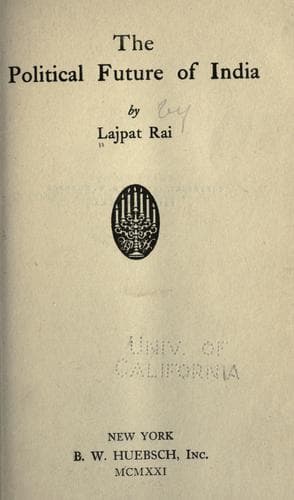
India -- History -- British occupation, 1765-1947; India -- Politics and government -- 1765-1947
authors of the Report do not propose to concede to it even such
beginnings of responsible government as they are prepared to grant to
the other provinces of India. The fact is that mere literacy does not
play an important part in the awakening of political consciousness in a
people. It is a useful ingredient of character required for the exercise
of political power but by no means essential.
POVERTY
The argument based on poverty is of still less force. On the other hand,
it is the best reason why the people of India should have the power to
determine and carry out their fiscal policy. We hope the admissions made
in Paragraph 135 of the Report which we bodily reproduce[2] will once
for all dispose of the silly statement, so often repeated even by men
who ought to know better, that materially India has been highly
prosperous under British rule. If so, how is it that in the language of
the Secretary of State for India and the Viceroy "enormous masses of the
population have little to spare for more than the necessaries of life"?
What about the prosperity of a province, one of the biggest in India
(the United Provinces), in which the number of landlords (not tenants
and farmers) whose income derived from their proprietary holdings
exceeds £20 ($100 a year, which comes to 30 cents a day for the whole
family), is about 126,000 out of a population of 48 millions!
Acceptance of the argument of poverty as sufficient to deprive people of
political right is putting a premium on it which is hardly creditable to
the political ethics of the twentieth century. It is the poorest and the
most ignorant in the community who most egregiously suffer at the hands
of autocracy. It is they who require protection from it. The wealthy and
the educated know how to placate the bureaucrat and get what they want.
It is the poor who pay the penalty of political helplessness, yet,
curiously, it is for them and in their interest that the English
Government in India proposes to withhold the power of the purse from the
proposed Indian Councils and insists on denying the Indian people even
the elements of responsible government. While we admit the general
justice and accuracy of the observations made under the head of "extent
of interest in political questions," "political capacity of the rural
population," we fail to see anything in them which justifies the
conclusion that the interests of the classes not politically minded will
be safer in the hands of the British officer, and on the whole better
protected by him than by his educated countrymen who are likely to get
the power in case of responsible government being conceded now. In our
judgment no greater argument for the immediate grant of a substantial
step in the direction of complete responsible government throughout
India and in all spheres of government, could be advanced than what is
involved in the following observation of the authors of the joint
Report:
Public-domain text, read in full here on John Shaqi.
Reviews
Reviews
No reviews yet
Be the first to share your thoughts on this work.
Elsewhere in the archive
Join the Discussion
Join the discussion
Sign in to leave a comment or review.
Sign InorCreate an account