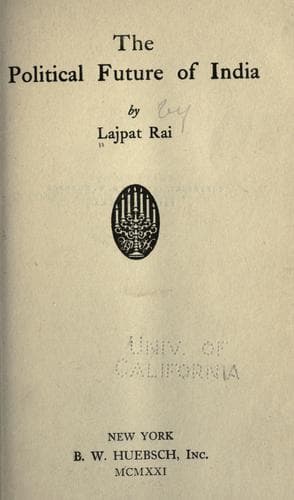
India -- History -- British occupation, 1765-1947; India -- Politics and government -- 1765-1947
"The rural classes have the greatest stake in the country because
they contribute most to its revenues; but they are poorly equipped
for politics and do not at present wish to take part in them.
Among them are a few great landlords and a larger number of yeoman
farmers. They are not ill-fitted to play a part in affairs, but
with few exceptions they have not yet done so. But what is perhaps
more important to appreciate than the mere content of political
life in India is its rate of growth. No one who has observed
Indian life during even the past five years can doubt that the
growth is rapid and is real. It is beginning to affect the large
landholders: here and there are signs of its beginning to affect
even the villages. But recent events, and above all the war, have
given it a new earnestness and a more practical character. Men are
coming to realise more clearly that India's political future is
not to be won merely by fine phrases: and that it depends on the
capacity of her people themselves to face difficulties and to
dispose of them. Hence comes the demand for compulsory education,
for industries, for tariffs, for social reform, for social, public
and even military service."
In the next paragraph, the authors approvingly give an extract from an
official report in which it is frankly admitted that the rural
population "may not be vocal, but they are certainly not voiceless." The
last meeting of the Indian Congress was attended by 700 farmer
delegates. Thousands of farmers have joined the Home Rule Leagues. The
statement that "hitherto they have regarded the official as their
representative in the Councils of the Government" is entirely devoid of
any truth. In their eyes the official is the Government itself. Some of
them may think that the official _represents_ the Government, but to say
that they regard the official as "_their representative_ in the Councils
of the Government" is a mere travesty of truth. The paragraph on the
"interests of the ryot" bristles with so many unwarranted assumptions
that we must enter an emphatic protest against its misleading nature.
But it gives us pleasure to accord our whole-hearted support to the
following statement with which the paragraph opens:
"It is just because the Indian ryot is inarticulate and has not
been directly represented in our deliberations that we feel bound
to emphasise the great claim he has upon our consideration. The
figure of the individual cultivator does not often catch the eye
of the Governments in Simla and Whitehall. It is chiefly in the
mass that they deal with him, as a consumer of salt or of
piece-goods, or unhappily too often as the victim of scarcity or
disease."
Public-domain text, read in full here on John Shaqi.
Reviews
Reviews
No reviews yet
Be the first to share your thoughts on this work.
Elsewhere in the archive
Join the Discussion
Join the discussion
Sign in to leave a comment or review.
Sign InorCreate an account