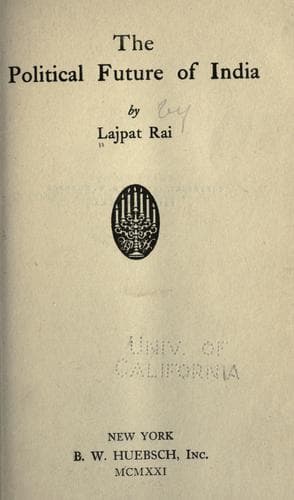
India -- History -- British occupation, 1765-1947; India -- Politics and government -- 1765-1947
"We cannot conclude without taking into due account the presence
of a considerable community of non-official Europeans in India. In
the main they are engaged in commercial enterprises; but besides
these are the missions, European and American, which in furthering
education, building up character, and inculcating healthier
domestic habits have done work for which India should be grateful.
There are also an appreciable number of retired officers and
others whose working life has been given to India, settled in the
cooler parts of the country. When complaints are rife that
European commercial interests are selfish and drain the country of
wealth which it ought to retain, it _is well to remind ourselves
how much of India's material prosperity is due to European
commerce_." [The italics are ours].
We have no desire to raise a controversy over the assumption which
underlies the last statement in the above extract. The authors are
themselves cognizant of it when they remark, later on, that the
"benefit" which India has received by her commercial development in
European hands is "not less because it was incidental and not the
purpose of the undertaking." These are matters on which the Indian
Nationalist may well hold his own opinion and yet endorse the spirit of
the following observations:
"Clearly it is the duty of British Commerce in India to identify
itself with the interests of India, which are higher than the
interests of any community; to take part in political life; to use
its considerable wealth and opportunities to commend itself to
India; and having demonstrated both its value and its good
intentions, to be content to rest like other industries on the new
foundation of Government in the wishes of the people. No less is
it the wish of Indian politicians to respect the expectations
which have been implicitly held out; to remember how India has
profited by commercial development which only British capital and
enterprise achieved; to bethink themselves that though the capital
invested in private enterprises was not borrowed under any
assurance that the existing form of government would endure, yet
the favourable terms on which money was obtained for India's
development were undoubtedly affected by the fact of British rule;
and to abstain from advocating differential treatment aimed not so
much at promoting Indian as at injuring British commerce."
Public-domain text, read in full here on John Shaqi.
Reviews
Reviews
No reviews yet
Be the first to share your thoughts on this work.
Elsewhere in the archive
Join the Discussion
Join the discussion
Sign in to leave a comment or review.
Sign InorCreate an account