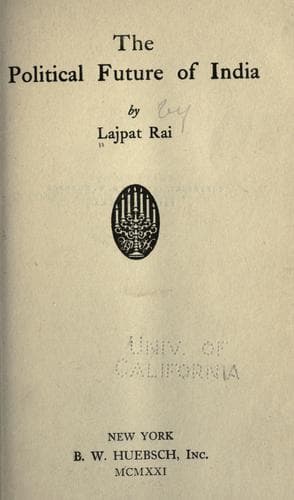
India -- History -- British occupation, 1765-1947; India -- Politics and government -- 1765-1947
The _Sessodias_ of Mewar called the _Ranas_ of Mewar (Udaipur) and the
Rahtores of Marwar (including Jodhpur, Bikaner, Rutlam, Kishangarh and
Alwar) have written many a glorious page of Mediaeval Indian history and
dyed it with their own blood as well as that of their adversaries. Not
only their men but their women have made themselves immortal by their
bravery, chivalry, purity and self-immolation. The one thing which
distinguishes the Indian Rajput from the peoples of other lands is that
he has never waged war against the poor, the helpless and the
defenceless. Numberless men gave their lives freely and ungrudgingly not
only in protecting the lives of their own women and children but also in
doing the same service to the women and children of their enemies. The
Rajput never fought an unfair fight. He never took advantage of the
helplessness of his enemy and always gave him right of way and the use
of his best weapons for a free and fair fight in the open. Anyone
desirous of knowing their deeds may read them in that poem in prose,
known as the Annals of Rajhasthan by Col. Todd. Col. Todd has drawn a
most faithful and thrilling picture of Rajput bravery and Rajput
chivalry in a language worthy of the best traditions of English
literature. Here and there in matters of minor details his authority has
been questioned; otherwise the results of his monumental labors still
remain the best picture of Rajput India. The Rajput States of India are
thus the objects of reverent honor to the 220 million Hindus of that
country. Next to the Rajput States comes the native ruling family of
Mysore as the representative of a very ancient Hindu Kingdom. The
Mahratta States are the remnants of the Mahratta Empire and the Sikhs
those of the Sikh Commonwealth. The biggest of all the Indian Native
States, Hyderabad, arose out of the ruins of the Mogul Empire and is
supposed to be the most powerful guardian of Moslem culture and
tradition. From this description the reader will at once see why the
Native States are so dear to the peoples of India and why the Indian
educated party has always stood by the Native States, whenever either
their treaty rights or the personal dignity and status of their chiefs
was threatened by the British authorities. Lord Dalhousie's policy of
annexation by lapse was so much resented by the people of India that it
had almost cost the British their Indian Empire. Only in the Native
States do the Indians see remaining traces of their former
independence. That fact alone covers all the defects of native rule or
misrule in the States, in their eyes. Some of these Native States have
been so well administered that in education, social reform and
industrial advancement they are far ahead of the neighboring British
territories. But their chief merit lies in the fact that ordinarily the
people get enough food to eat and are seemingly happier than British
subjects. This fact has been noticed by several competent observers of
Public-domain text, read in full here on John Shaqi.
Reviews
Reviews
No reviews yet
Be the first to share your thoughts on this work.
Elsewhere in the archive
Join the Discussion
Join the discussion
Sign in to leave a comment or review.
Sign InorCreate an account