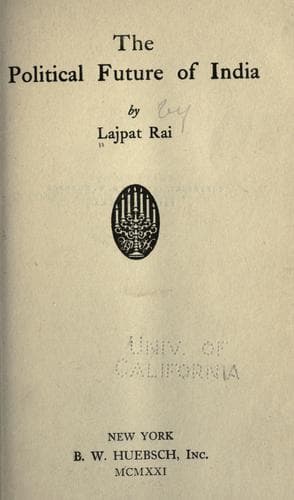
India -- History -- British occupation, 1765-1947; India -- Politics and government -- 1765-1947
In our judgment this part of the Montagu-Chelmsford Report is no less
important for the future of Indian democracy than the others that
directly deal with British India, and we hope that whatever might be
the policy as regards the existing States the new law will make it
impossible for the Government of India and the Secretary of State to
create any new States in the future. It is monstrous to transfer
millions of human beings from one kind of political rule to another like
so many cattle, as was done in 1911. The present rule of any Indian
Maharaja may be as good or as bad as that of a British Governor or
Lieutenant Governor, but the latter has in it greater democratic
potentialities than the former, for the mere fact, if for no other,
that, while the British are more or less amenable to world opinion, the
rulers of Native States are not. It is inhuman, and not in accord with
modern ideas of right and wrong to reward somebody's loyalty by giving
him power of life and death over numerous fellow beings, otherwise than
in due course of law. Even the mighty British Government is not the
owner of the bodies and souls of its subjects in India. How, then, can
it assume the right of abandoning them to the absolute rule of a single
individual, however worthy or loyal he may be? We hope this stupid way
of rewarding loyal services may be ended by an express provision to that
effect in the statute which will be passed relating to the
reorganization of the Government of India.
In this connection the following observations made in a leading
editorial of the _Servant of India_, Poona (February 16, 1919), are
worthy of attention:
Public-domain text, read in full here on John Shaqi.
Reviews
Reviews
No reviews yet
Be the first to share your thoughts on this work.
Elsewhere in the archive
Join the Discussion
Join the discussion
Sign in to leave a comment or review.
Sign InorCreate an account