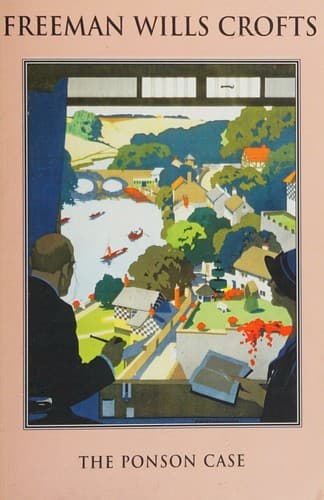
Detective and mystery stories; Murder -- Investigation -- Fiction; Police -- England -- Fiction
The more Tanner thought over it, the more likely this theory seemed.
It would explain the facts generally, as well as the secrecy with
which both parties had acted. And yet there were difficulties. This
annuity business was a difficulty. From Douglas’s point of view it was
easy enough to understand. If the blackmailer thought his receipts
were precarious, or if time was reducing or about to reduce the value
of the secret, it would be a natural step for him to try to convert
his vanishing doles into a fixed and certain income. But Sir William’s
motive would be different. His only hold on the preservation of his
secret was the expectation on Douglas’s part of sums yet to be paid.
If the manufacturer agreed to the annuity his hold would be gone. That
he should do so was inconceivable to Tanner. And yet apparently he
had. He had at least written the £3000 cheque.
But the second difficulty to the blackmail theory was more serious.
The wrong man had been murdered! If Douglas had been the victim it
would have fitted in well enough. It would have been argued that Sir
William had taken a desperate remedy to escape from an intolerable
situation. But Sir William’s death would have been the last thing
Douglas could have desired. He would never have cut off the source of
his income. No; attractive as the blackmail theory had seemed at
first, Tanner found its difficulties rather overwhelming.
He had by this time reached the Yard, and sitting down at his desk, he
lit a cigar, and continued his ruminations.
Suppose again that blackmail had been levied, where did Austin and
Cosgrove come in? They must in this case obviously have taken sides.
Either they must have been assisting Sir William to extricate himself,
or else they must have been party to the blackmail.
But as Tanner pondered these alternatives, he could not see how either
would meet the facts. If the cousins were acting for their relative,
they obviously would not have murdered him—it was a contradiction in
terms. Here again the wrong man had been killed.
On the other hand, it was difficult to see how they could have been in
league with Douglas against Sir William. Anything discreditable to the
manufacturer would react on both the son and nephew, and their threat
to make the matter public would therefore hardly be convincing. For
their own sakes the cousins would be as anxious as Sir William to keep
the thing quiet. It was also clear to Tanner that they would never
have put themselves in the power of a man like Douglas. If they had
wished to murder Sir William for his money, they would have done so at
some time when Douglas would not have witnessed the crime.
So far had Tanner progressed when he realised his argument really was
that Sir William could not have been murdered at all! He swore
angrily, and went back to see the point from which he had started.
Blackmail. It would seem, then, that blackmail could not be the
explanation. And yet . . . It was an attractive theory . . .
Public-domain text, read in full here on John Shaqi.
Reviews
Reviews
No reviews yet
Be the first to share your thoughts on this work.
Elsewhere in the archive
Join the Discussion
Join the discussion
Sign in to leave a comment or review.
Sign InorCreate an account