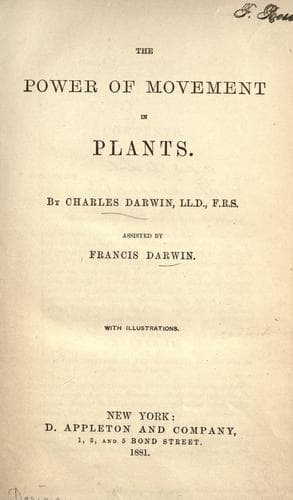
Botany; Geotropism; Plants -- Irritability and movements
We were therefore led to suspect that the apex was sensitive to
contact, and that an effect was transmitted from it to the upper part
of the radicle, which was thus excited to bend away from the touching
object. As a little loop of fine thread hung on a tendril or on the
petiole of a leaf-climbing plant, causes it to bend, we thought that
any small hard object affixed to the tip of a radicle, freely suspended
and growing in damp air, might cause it to bend, if it were sensitive,
and yet would not offer any mechanical resistance to its growth. Full
details will be given of the experiments which were tried, as the
result proved remarkable. The fact of the apex of a radicle being
sensitive to contact has never been observed, though, as we shall
hereafter see, Sachs discovered that the radicle a little above the
apex is sensitive, and bends like a tendril towards the touching
object. But when one side of the apex is pressed by any object, the
growing part bends away from the object; and this seems a beautiful
adaptation for avoiding obstacles in the soil, and, as we shall see,
for following the lines of least resistance. Many organs, when touched,
bend in one fixed direction, such as the stamens of Berberis, the lobes
of Dionaea, etc.; and many organs, such as tendrils, whether modified
leaves or flower-peduncles, and some few stems, bend towards a touching
object; but no case, we believe, is known of an organ bending away from
a touching object.
Sensitiveness of the Apex of the Radicle of Vicia faba.—Common beans,
after being soaked in water for 24 h., were pinned with the hilum
downwards (in the manner followed by Sachs), inside the cork lids of
glass-vessels, which were half filled with water; the sides and the
cork were well moistened, and light was excluded. As soon as the beans
had protruded radicles, some to a length of less than a tenth of an
inch, and others to a length of several tenths, little squares or
oblongs of card were affixed to the short sloping sides of their
conical tips. The squares therefore adhered obliquely with reference to
the longitudinal axis of the radicle; and this is a very necessary
precaution, for if the bits of card accidentally became displaced, or
were drawn by the viscid matter employed so as to adhere parallel to
the side of the radicle, although only a little way above the conical
apex, the radicle did not bend in the peculiar manner which we are here
considering. Squares of about the 1/20th of an inch (i.e. about 1½
mm.), or oblong bits of nearly the same size, were found to
be the most convenient and effective. We employed at first ordinary
thin card, such as visiting cards, or bits of very thin glass, and
various other objects; but afterwards sand-paper was chiefly employed,
for it was almost as stiff as thin card, and the roughened surface
favoured its adhesion. At first we generally used very thick gum-water;
and this of course, under the circumstances, never dried in the least;
Public-domain text, read in full here on John Shaqi.
Reviews
Reviews
No reviews yet
Be the first to share your thoughts on this work.
Elsewhere in the archive
Join the Discussion
Join the discussion
Sign in to leave a comment or review.
Sign InorCreate an account