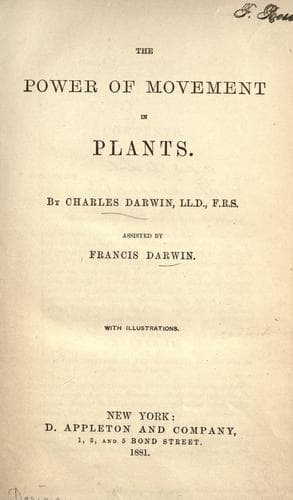
Botany; Geotropism; Plants -- Irritability and movements
The tips of 11 radicles were protected by moistened gold-beaters’ skin,
which adheres closely, for a length varying from 1½ to 2½ mm. After 22
h. to 24 h., 6 of these radicles were clearly bent towards or had come
into contact with the sieve; 2 were slightly curved in this direction,
and 3 not at all. All had grown well. Of 14 control specimens observed
at the same time, all excepting one had closely approached the sieve.
It appears from these cases that a cap of goldbeaters’ skin checks,
though only to a slight degree, the bending of the radicles to an
adjoining damp surface. Whether an extremely thin sheet of this
substance when moistened allows moisture from the air to pass through
it, we do not know. One case indicated that the caps were sometimes
more efficient than appears from the above results; for a radicle,
which after 23 h. had only slightly approached the sieve, had its cap
(1½ mm. in length) removed, and during the next 15½ h. it curved itself
abruptly towards the source of moisture, the chief seat of curvature
being at a distance of 2 to 3 mm. from the apex.
Vicia faba.—The tips of 13 radicles were coated with the grease for a
length of 2 mm.; and it should be remembered that with these radicles
the seat of chief curvature is about
4 or 5 mm. from the apex. Four of them were examined after 22h., three
after 26 h., and six after 36 h., and none had been attracted towards
the damp lower surface of the sieve. In another trial 7 radicles were
similarly treated, and 5 of them still pointed perpendicularly
downwards after 11 h., whilst 2 were a little curved towards the sieve;
by an accident they were not subsequently observed. In both these
trials the radicles grew well; 7 of them, which were at first from 4 to
11 mm. in length, were after 11 h. between 7 and 16 mm.; 3 which were
at first from 6 to 8 mm. after 26 h. were 11.5 to 18 mm. in length; and
lastly, 4 radicles which were at first 5 to 8 mm. after 46 h. were 18
to 23 mm. in length. The control or ungreased radicles were not
invariably attracted towards the bottom of the sieve. But on one
occasion 12 out of 13, which were observed for periods between 22 h.
and 36 h., were thus attracted. On two other occasions taken together,
38 out of 40 were similarly attracted. On another occasion only 7 out
of 14 behaved in this manner, but after two more days the proportion of
the curved increased to 17 out of 23. On a last occasion only 11 out of
20 were thus attracted. If we add up these numbers, we find that 78 out
of 96 of the control specimens curved themselves towards the bottom of
the sieve. Of the specimens with greased tips, 2 alone out of the 20
(but 7 of these were not observed for a sufficiently long time) thus
curved themselves. We can, therefore, hardly doubt that the tip for a
length of 2 mm. is the part which is sensitive to a moist atmosphere,
and causes the upper part to bend towards its source.
Public-domain text, read in full here on John Shaqi.
Reviews
Reviews
No reviews yet
Be the first to share your thoughts on this work.
Elsewhere in the archive
Join the Discussion
Join the discussion
Sign in to leave a comment or review.
Sign InorCreate an account