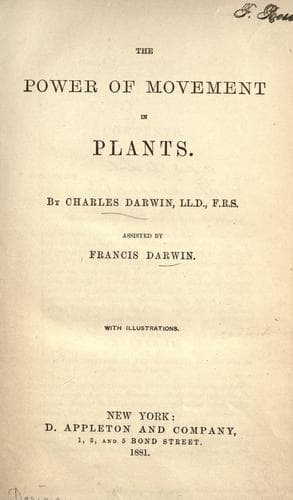
Botany; Geotropism; Plants -- Irritability and movements
When radicles of the bean are extended horizontally with squares of
card attached to the lower sides of their tips, the irritation thus
caused was always conquered by geotropism, which then acts under the
most favourable conditions at right angles to the radicle. But when
objects were attached to the radicles of any of the above-named genera,
suspended vertically, the irritation conquered geotropism, which latter
power at first acted obliquely on the radicle; so that the immediate
irritation from the attached object, aided by its after-effects,
prevailed and caused the radicle to bend upwards, until sometimes the
point was directed to the zenith. We must, however, assume that the
after-effects of the irritation of the tip by an attached object come
into play, only after movement has been excited. The tips of the
radicles of the pea seem to be more sensitive to contact than those of
the bean, for when they were extended horizontally with squares of card
adhering to their lower sides, a most curious struggle occasionally
arose, sometimes one and sometimes the other force prevailing, but
ultimately geotropism was always victorious; nevertheless, in two
instances the terminal part became so much curved upwards that loops
were subsequently formed. With the pea, therefore, the irritation from
an attached object, and from geotropism when acting at right angles to
the radicle, are nearly balanced forces. Closely similar results were
observed with the horizontally extended radicles of _Cucurbita
ovifera_,
when their tips were slightly cauterised on the lower side.
Finally, the several co-ordinated movements by which radicles are
enabled to perform their proper functions are admirably perfect. In
whatever direction the primary radicle first protrudes from the seed,
geotropism guides it perpendicularly downwards; and the capacity to be
acted on by the attraction of gravity resides in the tip. But Sachs has
proved[15] that the secondary radicles, or those emitted by the primary
one, are acted on by geotropism in such a manner that they tend to bend
only obliquely downwards. If they had been acted on like the primary
radicle, all the radicles would have penetrated the ground in a close
bundle. We have seen that if the end of the primary radicle is cut off
or injured, the adjoining secondary radicles become geotropic and grow
vertically downwards. This power must often be of great service to the
plant, when the primary radicle has been destroyed by the larvae of
insects, burrowing animals, or any other accident. The tertiary
radicles, or those emitted by the secondary ones, are not influenced,
at least in the case of the bean, by geotropism; so they grow out
freely in all directions. From this manner of growth of the various
kinds of radicles, they are distributed, together with their absorbent
hairs, throughout the surrounding soil, as Sachs has remarked, in the
most advantageous manner; for the whole soil is thus closely searched.
Public-domain text, read in full here on John Shaqi.
Reviews
Reviews
No reviews yet
Be the first to share your thoughts on this work.
Elsewhere in the archive
Join the Discussion
Join the discussion
Sign in to leave a comment or review.
Sign InorCreate an account