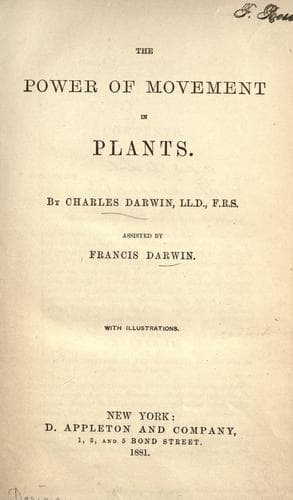
Botany; Geotropism; Plants -- Irritability and movements
(30.) Pancratium littorale (Amaryllideae).—The movements, much
magnified, of a leaf, 9 inches in length and inclined at about 45°
above the horizon, were traced during two days. On the first day it
changed its course completely, upwards and downwards and laterally, 9
times in 12 h.; and the figure traced apparently represented five
ellipses. On the second day it was observed seldomer, and was therefore
not seen to change its course so often, viz., only 6 times, but in the
same complex manner as before. The movements were small in extent, but
there could be no doubt about the circumnutation of the leaf.
(31.) Imatophyllum vel Clivia (sp.?) (Amaryllideae).—A long glass
filament was fixed to a leaf, and the angle formed by it with the
horizon was measured occasionally during three successive days. It fell
each morning until between 3 and 4 P.M., and rose at night. The
smallest angle at any time above the horizon was 48°, and the largest
50°; so that it rose only 2° at night; but as this was observed each
day, and as similar observations were nightly made on another leaf on a
distinct plant, there can be no doubt that the leaves move
periodically, though to a very small extent. The position of the apex
when it stood highest was .8 of an inch above its lowest point.
(32.) Pistia stratiotes (Aroideae, Fam. 30).—Hofmeister remarks that
the leaves of this floating water-plant are more highly inclined at
night than by day.[13] We therefore fastened a fine glass filament to
the midrib of a moderately young leaf, and on Sept. 19th measured the
angle which it formed with the horizon 14 times between 9 A.M. and
11.50 P.M. The temperature of the hot-house varied during the two days
of observation between 18½° and 23½° C. At 9 A.M. the filament stood at
32° above the horizon; at 3.34 P.M. at 10° and at 11.50 P.M. at 55°;
these two latter angles being the highest and the lowest observed
during the day, showing a difference of 45°. The rising did not become
strongly marked until between
5 and 6 P.M. On the next day the leaf stood at only 10° above the
horizon at 8.25 A.M., and it remained at about 15° till past 3 P.M.; at
5.40 P.M. it was 23°, and at 9.30 P.M. 58°; so that the rise was more
sudden this evening than on the previous one, and the difference in the
angle amounted to 48°. The movement is obviously periodical, and as the
leaf stood on the first night at 55°, and on the second night at 58°
above the horizon, it appeared very steeply inclined. This case, as we
shall see in a future chapter, ought perhaps to have been included
under the head of sleeping plants.
[13] ‘Die Lehre von der Pflanzenzelle,’ 1867, p. 327.
Public-domain text, read in full here on John Shaqi.
Reviews
Reviews
No reviews yet
Be the first to share your thoughts on this work.
Elsewhere in the archive
Join the Discussion
Join the discussion
Sign in to leave a comment or review.
Sign InorCreate an account