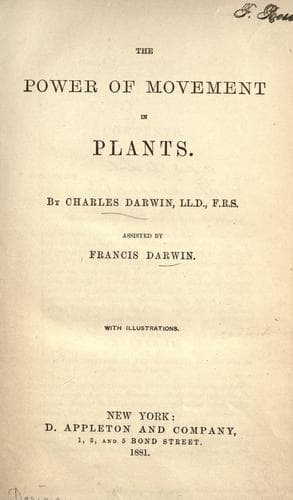
Botany; Geotropism; Plants -- Irritability and movements
The radicles, hypocotyls and epicotyls of seedling plants, even before
they emerge from the ground, and afterwards the cotyledons, are all
continually circumnutating. So it is with the stems, stolons,
flower-peduncles, and leaves of older plants. We may, therefore, infer
with a considerable degree of safety that all the growing parts of all
plants circumnutate. Although this movement, in its ordinary or
unmodified state, appears in some cases to be of service to plants,
either directly or indirectly—for instance, the circumnutation of the
radicle in penetrating the ground, or that of the arched hypocotyl and
epicotyl in breaking through the surface—yet circumnutation is so
general, or rather so universal a phenomenon, that we cannot suppose it
to have been gained for any special purpose. We must believe that it
follows in some unknown way from the manner in which vegetable tissues
grow.
We shall now consider the many cases in which circumnutation has been
modified for various special purposes; that is, a movement already in
progress is temporarily increased in some one direction, and
temporarily diminished or quite arrested in other directions. These
cases may be divided in two sub-classes; in one of which the
modification depends on innate or constitutional causes, and is
independent of external conditions, excepting in so far that the proper
ones for growth must be present. In the second sub-class the
modification depends to a large extent on external agencies, such as
the daily alternations of light and darkness, or light alone,
temperature, or the attraction of gravity. The first small sub-class
will be considered in the present chapter, and the second sub-class in
the remainder of this volume.
THE CIRCUMNUTATION OF CLIMBING PLANTS.
Public-domain text, read in full here on John Shaqi.
Reviews
Reviews
No reviews yet
Be the first to share your thoughts on this work.
Elsewhere in the archive
Join the Discussion
Join the discussion
Sign in to leave a comment or review.
Sign InorCreate an account