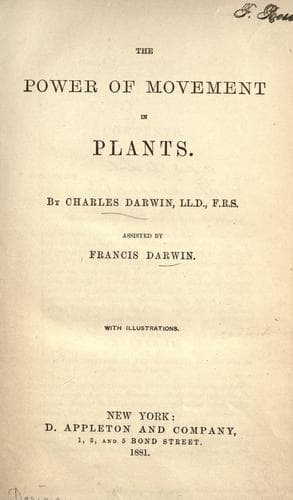
Botany; Geotropism; Plants -- Irritability and movements
We have said that the circumnutation of climbing plants differs from
that of ordinary plants chiefly by its greater amplitude. But most
leaves circumnutate
in an almost vertical plane, and therefore describe very narrow
ellipses, whereas the many kinds of tendrils which consist of
metamorphosed leaves, make much broader ellipses or nearly circular
figures; and thus they have a far better chance of catching hold of a
support on any side. The movements of climbing plants have also been
modified in some few other special ways. Thus the circumnutating stems
of Solnanum dulcamara can twine round a support only when this is as
thin and flexible as a string or thread. The twining stems of several
British plants cannot twine round a support when it is more than a few
inches in thickness; whilst in tropical forests some can embrace thick
trunks;[1] and this great difference in power depends on some unknown
difference in their manner of circumnutation. The most remarkable
special modification of this movement which we have observed is in the
tendrils of Echinocystis lobata; these are usually inclined at about
45° above the horizon, but they stiffen and straighten themselves so as
to stand upright in a part of their circular course, namely, when they
approach and have to pass over the summit or the shoot from which they
arise. If they had not possessed and exercised this curious power, they
would infallibly have struck against the summit of the shoot and been
arrested in their course. As soon as one of these tendrils with its
three branches begins to stiffen itself and rise up vertically, the
revolving motion becomes more rapid; and as soon as it has passed over
the point of difficulty, its motion coinciding with that from its own
weight, causes it to fall into its previously inclined position so
quickly, that the apex can be seen travelling like the hand of a
gigantic clock.
[1] ‘The Movements and Habits of Climbing Plants,’ p. 36.
A large number of ordinary leaves and leaflets and a few
flower-peduncles are provided with pulvini; but this is not the case
with a single tendril at present known. The cause of this difference
probably lies in the fact, that the chief service of a pulvinus is to
prolong the movement of the part thus provided after growth has ceased;
and as tendrils or other climbing-organs are of use only whilst the
plant is increasing in height or growing, a pulvinus which served to
prolong their movements would be useless.
Public-domain text, read in full here on John Shaqi.
Reviews
Reviews
No reviews yet
Be the first to share your thoughts on this work.
Elsewhere in the archive
Join the Discussion
Join the discussion
Sign in to leave a comment or review.
Sign InorCreate an account