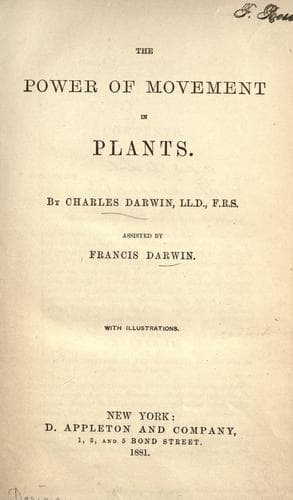
Botany; Geotropism; Plants -- Irritability and movements
From the several cases above given, there can be no doubt that the
position of the leaves at night affects their temperature through
radiation to such a degree, that when exposed to a clear sky during a
frost, it is a question of life and death. We may therefore admit as
highly probable, seeing that their nocturnal position is so well
adapted to lessen radiation, that the object gained by their often
complicated sleep movements, is to lessen the degree to which they are
chilled at night. It should be kept in mind that it is especially the
upper surface which is thus protected, as it is never directed towards
the zenith, and is often brought into close contact with the upper
surface of an opposite leaf or leaflet.
We failed to obtain sufficient evidence, whether the better protection
of the upper surface has been gained from its being more easily injured
than the lower surface, or from its injury being a greater evil to the
plant. That there is some difference in constitution between the two
surfaces is shown by the following cases. Cassia floribunda was exposed
to a clear sky on a sharp frosty night, and several leaflets which had
assumed their nocturnal dependent position with their lower surfaces
turned outwards so as to be
exposed obliquely to the zenith, nevertheless had these lower surfaces
less blackened than the upper surfaces which were turned inwards and
were in close contact with those of the opposite leaflets. Again, a pot
full of plants of Trifolium resupinatum, which had been kept in a warm
room for three days, was turned out of doors (Sept. 21st) on a clear
and almost frosty night. Next morning ten of the terminal leaflets were
examined as opaque objects under the microscope. These leaflets, in
going to sleep, either turn vertically upwards, or more commonly bend a
little over the lateral leaflets, so that their lower surfaces are more
exposed to the zenith than their upper surfaces. Nevertheless, six of
these ten leaflets were distinctly yellower on the upper than on the
lower and more exposed surface. In the remaining four, the result was
not so plain, but certainly whatever difference there was leaned to the
side of the upper surface having suffered most.
Public-domain text, read in full here on John Shaqi.
Reviews
Reviews
No reviews yet
Be the first to share your thoughts on this work.
Elsewhere in the archive
Join the Discussion
Join the discussion
Sign in to leave a comment or review.
Sign InorCreate an account