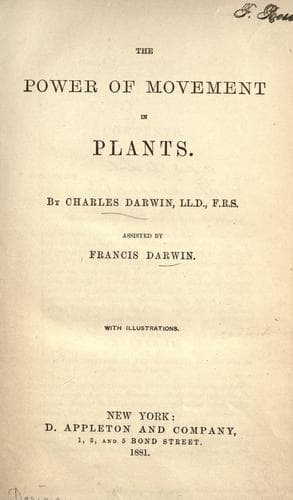
Botany; Geotropism; Plants -- Irritability and movements
Another analogous fact deserves notice: we observed on several
occasions that a greater number of free leaves were injured on the
branches which had been kept motionless by some of their leaves having
been pinned to the corks, than on the other branches. This was
conspicuously the case with those of Melilotus Petitpierreana, but the
injured leaves in this instance were not actually counted. With Arachis
hypogaea, a young plant with 7 stems bore 22 free leaves, and of these
5 were injured by the frost, all of which were on two stems, bearing
four leaves pinned to the cork-supports. With Oxalis carnosa, 7 free
leaves were injured, and every one of them belonged to a cluster of
leaves, some of which had been pinned to the cork. We could account for
these cases only by supposing that the branches which were quite free
had been slightly waved about by the wind, and that their leaves had
thus been a little warmed by the surrounding warmer air. If we hold our
hands motionless before a hot fire, and then wave them about, we
immediately feel relief; and this is evidently an analogous, though
reversed, case. These several facts—in relation to leaves pinned close
to or a little above the cork-supports—to their tips projecting beyond
it—and to the leaves on branches kept motionless—seem to us curious, as
showing how a difference, apparently trifling, may determine the
greater or less injury of the leaves. We may even infer as probable
that the less or greater destruction during a frost of the leaves on a
plant which does not sleep, may often depend on the greater or less
degree of flexibility of their petioles and of the branches which bear
them.
NYCTITROPIC OR SLEEP MOVEMENTS OF COTYLEDONS.
Public-domain text, read in full here on John Shaqi.
Reviews
Reviews
No reviews yet
Be the first to share your thoughts on this work.
Elsewhere in the archive
Join the Discussion
Join the discussion
Sign in to leave a comment or review.
Sign InorCreate an account