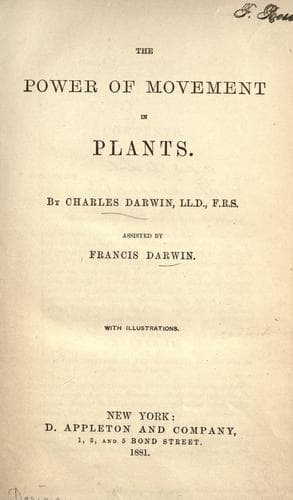
Botany; Geotropism; Plants -- Irritability and movements
the plants; at noon they were placed before the same north-east window,
and at night the leaves slept in the usual manner and awoke on the
following morning. At noon on this day (8th) the plants, after having
been left before the north-east window for 5 h. 45 m. and thus
illuminated (though not brightly, as the sky was cloudy during the
whole time), were replaced in the dark cupboard, and at 3 P.M. the
position of the leaves was very little, if at all, altered, so that
they are not quickly affected by darkness; but by 10.15 P.M. all the
leaves which had faced the north-east sky during the 5 h. 45 m. of
illumination stood vertical, whereas those on the back of the plant
retained their diurnal position. On the following morning (9th) the
leaves awoke as on the two former occasions in the dark, and they were
kept in the dark during the whole day; at night a very few of them
became vertical, and this was the one instance in which we observed any
inherited tendency or habit in this plant to sleep at the proper time.
That it was real sleep was shown by these same leaves reassuming their
diurnal position on the following morning (10th) whilst still kept in
the dark.
The pot was then (9.45 A.M. 10th) replaced, after having been kept for
36 h. in darkness, before the north-east window; and at night the
blades of all the leaves (excepting a few on the back of the plants)
became conspicuously vertical.
At 6.45 A.M. (11th) after the plants had been illuminated on the same
side as before during only 25 m., the pot was turned round, so that the
leaves which had faced the light now faced the interior of the room,
and not one of these went to sleep at night;
whilst some, but not many, of those which had formerly stood facing the
back of the room and which had never before been well illuminated or
gone to sleep, now assumed a vertical position at night. On the next
day (12th) the plant was turned round into its original position, so
that the same leaves faced the light as formerly, and these now went to
sleep in the usual manner. We will only add that with some young
seedlings kept in the greenhouse, the blades of the first pair of true
leaves (the cotyledons being hypogean) stood during the day almost
horizontally and at night almost vertically.
A few observations were subsequently made on the circumnutation of
three leaves, whilst facing a north-east window; but the tracings are
not given, as the leaves moved somewhat towards the light. It was,
however, manifest that they rose and fell more than once during the
daytime, the ascending and descending lines being in parts extremely
zigzag. The nocturnal fall commenced about 7 P.M., and the leaves had
risen considerably by 6.45 A.M. on the following morning.
Leguminosae.—This Family includes many more genera with sleeping
species than all the other families put together. The number of the
tribes to which each genus belongs, according to Bentham and Hooker’s
arrangement, has been added.
Public-domain text, read in full here on John Shaqi.
Reviews
Reviews
No reviews yet
Be the first to share your thoughts on this work.
Elsewhere in the archive
Join the Discussion
Join the discussion
Sign in to leave a comment or review.
Sign InorCreate an account