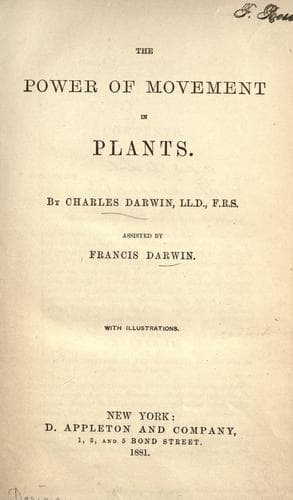
Botany; Geotropism; Plants -- Irritability and movements
Seedlings of Githago segetum were feebly illuminated from above in the
morning before their cotyledons had expanded, and they remained closed
for the next 40 h. Other seedlings were placed in the dark after their
cotyledons had opened in the morning and these did not begin to close
until about 4 h. had elapsed. The cotyledons of Oxalis rosea sank
vertically downwards after being left for 1 h. 20 m. in darkness; but
those of some other species of Oxalis were not affected by several
hours of darkness. The cotyledons of several species of Cassia are
eminently susceptible to changes in the degree of light to which they
are exposed: thus seedlings of an unnamed S. Brazilian species (a large
and beautiful tree) were brought out of the hot-house and placed on a
table in the middle of a room with two north-east and one north-west
window, so that they were fairly well illuminated, though of course
less so than in the hot-house, the day being moderately bright; and
after 36 m. the cotyledons which had been horizontal rose up vertically
and closed together as when asleep; after thus remaining on the table
for 1 h. 13 m. they began to open. The cotyledons of young seedlings of
another Brazilian species and of C. neglecta, treated in the same
manner, behaved similarly, excepting that they did not rise up quite so
much: they again became horizontal after about an hour.
Here is a more interesting case: seedlings of Cassia tora in two pots,
which had stood for some time on the table in the room just described,
had their cotyledons horizontal. One pot was now exposed for 2 h. to
dull sunshine, and the cotyledons
remained horizontal; it was then brought back to the table, and after
50 m. the cotyledons had risen 68° above the horizon. The other pot was
placed during the same 2 h. behind a screen in the room, where the
light was very obscure, and the cotyledons rose 63° above the horizon;
the pot was then replaced on the table, and after 50 m. the cotyledons
had fallen 33°. These two pots with seedlings of the same age stood
close together, and were exposed to exactly the same amount of light,
yet the cotyledons in the one pot were rising, whilst those in the
other pot were at the same time sinking. This fact illustrates in a
striking manner that their movements are not governed by the actual
amount, but by a change in the intensity or degree of the light. A
similar experiment was tried with two sets of seedlings, both exposed
to a dull light, but different in degree, and the result was the same.
The movements of the cotyledons of this Cassia are, however, determined
(as in many other cases) largely by habit or inheritance, independently
of light; for seedlings which had been moderately illuminated during
the day, were kept all night and on the following morning in complete
darkness; yet the cotyledons were partially open in the morning and
remained open in the dark for about 6 h. The cotyledons in another pot,
Public-domain text, read in full here on John Shaqi.
Reviews
Reviews
No reviews yet
Be the first to share your thoughts on this work.
Elsewhere in the archive
Join the Discussion
Join the discussion
Sign in to leave a comment or review.
Sign InorCreate an account