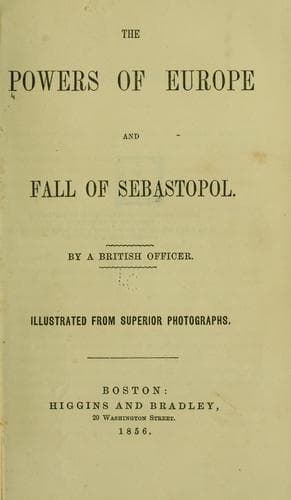
The Powers of Europe and Fall of SebastopolA British officer
History
The Powers of Europe and Fall of Sebastopol
A British officer
Crimean War, 1853-1856; Europe -- History -- 1789-1900
hand to hand, for an entrance.
The party in the rear of the fort had thrown their ladders, like
bridges, across the ditch, resting them on the slanting stakes, and
springing on them, drove back their guards. Fifty men, bearing axes,
now discovered the gate, which soon fell beneath their blows, and
they rushed in to a nearer contest. The little garrison, stern in
their resistance, did what they could. Powis, Gips, Holloway and
Oates, fell on the ramparts. Nixon, Shaw, and Rudd, were not long
behind. Scarcely an officer was left; and yet the struggle continued.
At length, when only eighty-six men remained, they surrendered, and
the Picurina passed to the allies. Only one hour had that fierce
conflict lasted, yet of our troops four officers and fifty men had
fallen, and fifteen officers and two hundred and fifty men were
wounded. Phillipon felt deeply the loss of this fort. He did not
conceal from his soldiers the increase of danger to their city from
it; but he stimulated their courage by reminding them that death
was far preferable to an abode in the English prison-ships. They
deeply felt that appeal, and, with the first dawn of light, their
guns were manned with renewed activity. These were turned against
the fort, and so raked it that it was impossible for our troops to
remain there, and it was deserted. This victory gave fresh courage
to the besiegers. Our whole force was occupied, the three succeeding
nights, in erecting new batteries, and in extending the parallels
and communications. In the daytime, comparatively little could be
done, as the fire from the town so galled the workmen. Repeatedly
they dismounted our guns, and destroyed the defences which had been
erected to shield the laborers, so that we were obliged to wait until
the darkness prevented their marksmen from taking aim, in order to
carry on our works. The night of the 27th, an attempt was made to
destroy the dam, which had been built for the purpose of forming an
inundation, and lessening the space where our troops could work; but
the moon had now made her appearance, and shone so brightly that the
effort was unsuccessful.
On this night a most daring feat was performed by one of the French.
Having disguised himself, he crept over the wall, and concealed
himself until he had caught the watchword for the night. Then,
boldly mingling with the troops, he proceeded to the works. Here the
engineer had placed a line to mark the direction of the sap. Just
before the workmen arrived, he moved the string, until he brought it
within complete range of the castle guns. The men commenced work at
once, but the light of the moon enabled the guns to tell with fearful
precision upon them; and it was not until a severe loss had been
sustained, that the mistake was discovered. Meanwhile, the intruder
stole quietly back to his old quarters, which he reached unmolested.
Public-domain text, read in full here on John Shaqi.
Reviews
Reviews
No reviews yet
Be the first to share your thoughts on this work.
Elsewhere in the archive
Join the Discussion
Join the discussion
Sign in to leave a comment or review.
Sign InorCreate an account