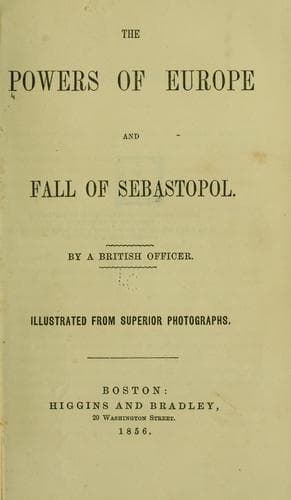
The Powers of Europe and Fall of SebastopolA British officer
History
The Powers of Europe and Fall of Sebastopol
A British officer
Crimean War, 1853-1856; Europe -- History -- 1789-1900
After this, no further attempt was made; and yet the soldiers would
not retire, but remained passive and unflinching, under the fire of
the enemy. It was now midnight. Already two thousand brave men had
fallen, when Wellington, who was watching the progress of the attack
from a height close to the quarries, sent orders that the troops
should retire and re-form for a second assault. But so great was the
confusion, that many of the officers did not receive the orders, and
so endeavored to prevent the soldiers from leaving, which occasioned
many deaths.
But the gallant defenders of Badajos, although successful at the
breaches, found that there was no time to look idly on. The whole
city was girdled by fire. The third division still maintained its
ground at the castle; the fifth were engaged at the Pardaleres, and
on the right of the Guadiana, while General Walker’s brigade was
escalading the bastion of San Vincente. This brigade had stolen
silently along the banks of the river, the noise of its ripple having
drowned the sound of their foot-steps until they reached the barrier
gate. Just then the explosion took place at the breaches; and by
its light the French sentinels discovered their assailants. In
an instant, a sharp musketry was opened upon them. The Portuguese
troops, panic-struck, threw down the scaling-ladders which had been
intrusted to them; but the British snatched them up, and reared them
against the walls, which, in this place, were thirty feet high.
Unfortunately, the ladders were too short, and this placed them in
a most perilous and uncomfortable position. A small mine was sprung
beneath their feet, adding its quota to the fearful number of the
dead; beams of wood and shells, fraught with living fire, were
rolled upon their heads, while showers of grape from the flanks
swept the ditch, dealing death-blows thick and fast on every side.
But, fortunately for our troops, the reinforcement to assist in the
defence of the castle was just at this time called for, and a part of
the walls lower than the rest was left unmanned. Three ladders were
hastily placed here, but they were still too short. But British valor
and ingenuity soon overcame this difficulty. A soldier, raised in
the arms of his comrades, sprang to the top; another followed. These
drew their comrades after them, and soon, in spite of the constant
fire which the French kept up, they ascended in such numbers, that
they could not be driven back. Dividing, on their entrance, one-half
entered the town, while the other, following the ramparts, attacked
and won three bastions. Just as the last was yielding, General Walker
fell, covered with wounds. A soldier, who stood near him, cried out,
“A mine! a mine!” At that word, those troops which had crossed the
strong barrier, whom neither the deepness of the ditch nor the height
of the wall could appal, who flinched not a moment at the deadly fire
of the enemy, shrank back at a chimera of their own raising. Their
Public-domain text, read in full here on John Shaqi.
Reviews
Reviews
No reviews yet
Be the first to share your thoughts on this work.
Elsewhere in the archive
Join the Discussion
Join the discussion
Sign in to leave a comment or review.
Sign InorCreate an account