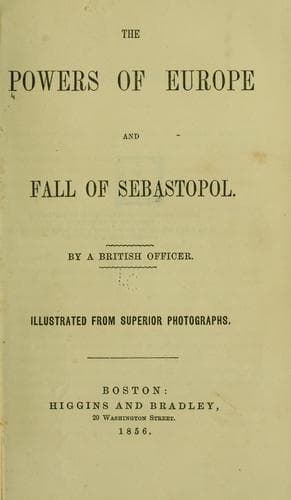
The Powers of Europe and Fall of SebastopolA British officer
History
The Powers of Europe and Fall of Sebastopol
A British officer
Crimean War, 1853-1856; Europe -- History -- 1789-1900
That volley, however, proved fatal to our brave
commander. A musket ball struck him in the temple, and he expired
without a struggle. After his fall, it was ascertained that he had
been wounded on the 16th, but had carefully concealed it from every
one but his servant. His wound, for want of surgical assistance, had
assumed a very serious aspect.
Again the French pressed on, and, attacking the Highland division,
drove them back in great disorder. But the brigade of heavy cavalry
now came to their assistance, and again the assailants fell back. A
column, two thousand strong, bore down upon the 92d regiment, which
immediately formed itself into a line, and, charging on the foe,
broke their centre. The French were now reinforced by their cavalry,
and the British by the brigade of heavy dragoons. A contest then
ensued which has hardly a parallel in modern warfare. The determined
valor of the British, however, conquered, and the French retired
behind their infantry. It was at this time that Sir William Ponsonby
was killed. He led his brigade against the Polish lancers, and took
two hundred prisoners; but, riding on in advance of his troops, he
entered a newly-ploughed field, when his horse stuck in the mire,
and he found it impossible to proceed. At this instant, a body of
lancers rode up. Sir William saw that his fate was inevitable. He
took out his watch and a picture, and desired some one near to send
them to his wife. A moment after, he fell, pierced with seven lance
wounds.
At the farm of La Haye Sainte, the French succeeded in cutting off
the communication of the German troops stationed there, and put them
all to the bayonet. Here they maintained their position, until the
final attack in the evening. The combat now raged with unabated fury.
Every inch of ground was disputed on both sides, and neither gave way
until every means of resistance was exhausted. The field of battle
was heaped with the dead; and yet the attack grew more impetuous, and
the resistance more obstinate. The continued reverberations of more
than six hundred pieces of artillery, the fire of the light troops,
the frequent explosions of caissons blown up by shells, the hissing
of balls, the clash of arms, the roar of the charges, and the shouts
of the soldiery, produced a commingling of sounds whose effect it
would be impossible to describe. Still, the contest raged on. After
the advantage gained at La Haye Sainte, Napoleon threw the masses
of both infantry and cavalry upon the British centre, which was now
exposed. The first battalions gave way under their impetuous attack,
and the French cavalry rushed on to carry the guns on the plains. An
English ambuscade ran to receive them. The slaughter was horrible.
Neither party yielded a step. Three times the French were on the
point of forcing their position, and three times they were driven
back. They cut to pieces the battalions of the English, who were slow
or unskilful in their movements, but could make no impression on the
Public-domain text, read in full here on John Shaqi.
Reviews
Reviews
No reviews yet
Be the first to share your thoughts on this work.
Elsewhere in the archive
Join the Discussion
Join the discussion
Sign in to leave a comment or review.
Sign InorCreate an account