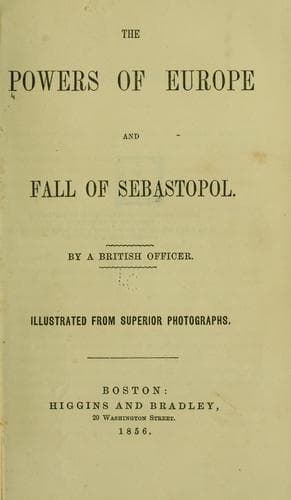
The Powers of Europe and Fall of SebastopolA British officer
History
The Powers of Europe and Fall of Sebastopol
A British officer
Crimean War, 1853-1856; Europe -- History -- 1789-1900
History informs us that the horrors of that night exceeded even
the tremendous scenes of the day. The French were in complete
confusion. Carriages and horsemen marched over the fainting and
exhausted infantry. The officers tried in vain to rally their men,
that they might retreat in order. The first flash of a Prussian gun
would scatter them, in the wildest confusion. Thousands fell in
the confusion of the retreat, and thousands more were crushed to
death, or drowned in crossing the rivers. Napoleon himself but just
escaped with his liberty. His carriage was stopped, his postilion and
coachman killed, and the door of his coach torn open just in season
to witness his escape from the other side. While Blucher led on the
Prussians in this murderous pursuit, the Duke of Wellington again
led his army upon the field of battle. The wild tumult and confusion
which had pervaded it through the day was now stilled, but the groans
of the wounded and the shrieks of the dying were heard on every side.
The English re-trod the battle-field, and searched out their wounded
comrades, and hastily dressed their wounds. They then constructed
litters, and on these carriages were the sick and wounded borne to
the hospitals of Brussels and Antwerp.
I have somewhere read a description, written by an eye-witness of
the scenes of the night and following day, which I will beg leave of
my readers to transcribe here. He says: “The mangled and lifeless
bodies were, even then, stripped of every covering--everything of the
smallest value was already carried off. The road between Waterloo
and Brussels, which passes for nine miles through the forest of
Soigny, was choked up with scattered baggage, broken wagons and dead
horses. The heavy rains and the great passage upon it rendered it
almost impassable, so that it was with extreme difficulty that the
carriages containing the wounded could be brought along. The way was
lined with unfortunate men, who had crept from the field; and many
were unable to go further, and laid down and died. Holes dug by the
wayside served as their graves, and the road for weeks afterwards was
strewed with the tattered remains of their clothes and accoutrements.
In every village and hamlet,--in every part of the country for thirty
miles round,--the wounded were found wandering, the Belgian and
Dutch stragglers exerting themselves to the utmost to reach their
own homes. So great was the number of those needing care, that,
notwithstanding the most active exertions, the last were not removed
to Brussels until the Thursday following.
Public-domain text, read in full here on John Shaqi.
Reviews
Reviews
No reviews yet
Be the first to share your thoughts on this work.
Elsewhere in the archive
Join the Discussion
Join the discussion
Sign in to leave a comment or review.
Sign InorCreate an account