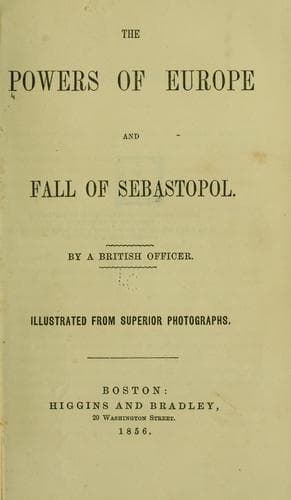
The Powers of Europe and Fall of SebastopolA British officer
History
The Powers of Europe and Fall of Sebastopol
A British officer
Crimean War, 1853-1856; Europe -- History -- 1789-1900
The first time the young Sultan presented himself to the eyes of
his subjects he was dressed in an European trousers and coat, over
which was thrown the imperial cloak, fastened by a diamond aigrette.
On his breast he wore the decoration of the Nicham Iflichar; his
head was covered with the fez, surmounted by a diamond aigrette.
The new king, while thus continuing the costume of his father,
nevertheless presented only a pale resemblance to him. Simple
without affectation, he cast around him glances full of softness
and benevolence. Everything announced in him the _debonnaire_
successor of an inflexible ruler; nothing hitherto had indicated
what great and precious qualities were concealed beneath the modest
and tranquil exterior. He was received favorably by his people, but
without any demonstration of enthusiasm. It was feared that this
delicate youth could scarcely be equal to the importance of his
duties. People pitied him, and, at the same time, trembled for the
future prospects of the country. The women alone, touched by his
youth and his appearance of kindness, manifested their sympathy
for him openly. When he went through Constantinople to the Mosque
of Baiezid, they ran towards him from all parts: “Is not our son
handsome?” they cried, adopting him with affection. When he was only
seventeen years of age, the official cry was heard in the streets
of Constantinople, “His Highness, our most magnificent lord, Abdul
Medjid, has risen to the throne! God will that his reign make the
happiness of his people!” The new monarch soon began to play the part
of a reformer. He assured to all his subjects, without exception,
perfect security for their lives and fortunes, a regular mode of
taxation, as also of recruiting the army; he abolished the monopoly
and venality of the public offices; insured the public administration
of justice and the free transmission of property; and founded all the
public institutions and administrations upon the systems of Europe,
particularly of France, yet with every attention to the peculiar
customs and prejudices of his own people. Abdul Medjid speedily
became the idol with all classes. Their esteem was increased by his
extreme amiability of temper, and heightened almost to infatuation
by the taste for literature which he displayed, and for his ardent
endeavors to raise the educational character of his subjects. The
reign of Abdul has been sullied by no execution, by no act of
cruelty. None of his ministers have ever lost their lives along with
their office and power. He has been very kind to his brother, Abdul
Aziz Effendi, allowing him both life and liberty, and making him a
frequent companion. In the troubles which agitated Western Europe
in 1848 and 1849, the Sultan acted a noble part in refusing to
deliver up, at the dictation of Russia, certain Hungarian and other
refugees, who had fled to him for shelter. In this firm course he was
supported, both by his own people, and also by France and England.
Public-domain text, read in full here on John Shaqi.
Reviews
Reviews
No reviews yet
Be the first to share your thoughts on this work.
Elsewhere in the archive
Join the Discussion
Join the discussion
Sign in to leave a comment or review.
Sign InorCreate an account