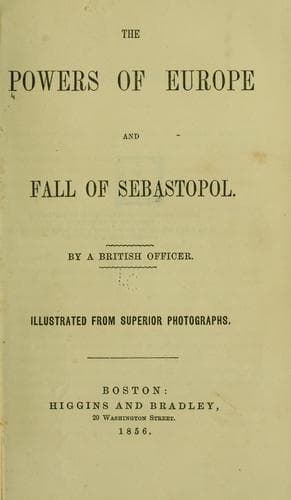
The Powers of Europe and Fall of SebastopolA British officer
History
The Powers of Europe and Fall of Sebastopol
A British officer
Crimean War, 1853-1856; Europe -- History -- 1789-1900
The Eastern tyrant orders any individual to be seized and put to
death for a look, much more for a mutinous word. He walks through
his capital, perhaps in disguise, and settles some dispute between
his subjects by ordering one to give up his property to another,
because he thinks, upon a moment’s inquiry, that the latter has a
right to it, or merely because his caprice makes him lean to one
rather than the other. He hears a charge against a man, and at once
strangles him on the spot; or he takes a dislike, and, without any
pretext at all, kills him, and sells his family for slaves. He covets
some one’s house, or garden, or jewel, or wife, and instantly seizes
it, or kills the owner that he may take it. Even this is not the
worst that the people suffer; for, were this all, men might be safe
by keeping at a distance, and the despot cannot be everywhere. But
where he himself is not, his deputies, his bashaws, or, as in some
countries they are called, his beglerbegs, are, and their subaltern
oppressors. Each has all the sovereign’s prerogatives in his own
person; and though they are all liable to be summarily punished, not
only by removal, but by being strangled with the bowstring sent to
be inflicted upon them, and although the prince does now and then
so punish wicked governors, yet he has a direct interest in their
exactions; for one of his largest revenues is the succeeding as heir
to all persons in his service; and in case they should conceal, or
secretly make over to their family the gains they have made in the
public service, the Sultan, during their life, squeezes the money
from them, and puts them to the tortures by the bastinado--severe
strokes on the soles of the feet--and by other torments, in order
to discover their property. The bowstring is used in a way quite
characteristic of the Turkish despotism. The Sultan, or his vizier,
if he be the person ordering the punishment, sends an officer,
generally one of very inferior rank, to the bashaw who has been
complained of, and whose conduct has, behind his back, been examined
by the government at Constantinople. He carries a bowstring with him,
and the order of the Sultan in writing, sealed with the imperial
signet, dipped into black ink, and signed with the Sultan’s cipher of
toghra. The bashaw, if he has a power in his hands which enables him
to set the sovereign at defiance, and to rebel against his authority,
avoids seeing the messenger, and puts him to death on some pretext,
as having him waylaid, and representing him as killed by banditti.
But if not, he at once, on receiving the messenger’s communication,
kisses the sealed paper and the bowstring, bares his neck, and allows
the man to strangle him, when his body is either buried privately,
or thrown to be devoured by dogs, according as the people, or the
troops, at the seat of his government, are well or ill disposed
towards his person.
Public-domain text, read in full here on John Shaqi.
Reviews
Reviews
No reviews yet
Be the first to share your thoughts on this work.
Elsewhere in the archive
Join the Discussion
Join the discussion
Sign in to leave a comment or review.
Sign InorCreate an account