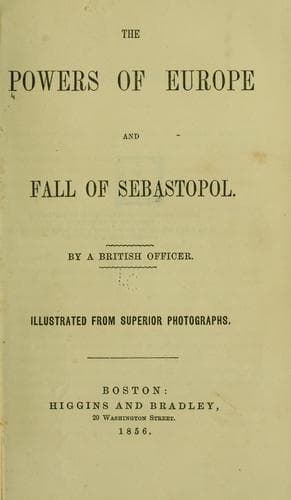
The Powers of Europe and Fall of SebastopolA British officer
History
The Powers of Europe and Fall of Sebastopol
A British officer
Crimean War, 1853-1856; Europe -- History -- 1789-1900
Of his early life but little is known. His origin is Croatian; his
native place Vlaski, a village in the district of Ogulini, thirteen
leagues from Fiume, on the Adriatic Sea. He was born in 1801; the
religion of his forefathers, and of his youthful years, was the
Greek united faith, namely, that branch of the Greek worship subject
to the Roman Pontiff. He received a liberal education. His father
enjoyed the important charge of Lieutenant-Administrator of the
district, and his uncle was invested with ecclesiastical functions.
His instruction in mathematics and military engineering he received
at the military school of Thurm, near Carlstadt, in Transylvania; and
in 1822, when 21 years of age, after having distinguished himself
in his studies, he entered the corps of _Ponts et Chaussées_ in the
Austrian service, with the rank of lieutenant, that body having just
been organized by the government.
At twenty-nine he left the Austrian service; but the true cause of
his taking this step has always remained a mystery. Many attributed
it to a family misfortune; some to a quarrel he had with his
superiors, followed by acts that would have subjected him to a
court-martial.
Having made his escape, he passed into Bosnia in 1830, where he
arrived wholly unknown, and it was only with difficulty he was able
to engage himself as a servant in Kosrew Pacha’s house, who was then
at Bosna-Serai.
The _second reforming Sultan_ had of late organized his troops on
a principle of reform, not only as to discipline, but also as to
the mode of equipment. Only a year, the wide and overflowing dress,
the majestic turbans, the silken shawls and rich furs had given
way to the more simple _fez_ and to the European _pantaloon_. He
began himself to assume that costume. The Khatti Sherif ordering
this change was only promulgated on the 3d of March, 1829, and the
sensation which the new dress occasioned among the people did not
fail, according to eye-witnesses, to draw forth tears and public
mourning.
All the regular troops of the army he had formed abandoned, whether
they liked it or not, the picturesque and rich costume, adopted
the new uniform, and accepted the command of foreign officers. An
indispensable condition to the advancement of a foreigner in the
Turkish service was conversion to Islamism, and Latkes became a
Mussulman, under the cognomen of Omer.
Meanwhile Old Turkey was clamorous in its protests against the
progress of reform; nor was it long before its indignation broke out
into acts of violence and bloodshed. Popular fury was often directed
against Europeans, who were regarded as abetters of reform; and in
August, 1831, ten thousand houses belonging to Europeans were a prey
to the flames.
Public-domain text, read in full here on John Shaqi.
Reviews
Reviews
No reviews yet
Be the first to share your thoughts on this work.
Elsewhere in the archive
Join the Discussion
Join the discussion
Sign in to leave a comment or review.
Sign InorCreate an account